Satisfying Shakespearean Ways To Tell Someone To Go Away #4: Avaunt!

Photo by Andrea Piacquadio on Pexels.com

There are times when each of us needs to tell someone to go away. Adding a Shakespearean flavour to it lends both style and emphasis to any ejection of a bothersome person.  It can also deliver a most satisfying sense of accomplishment to lovers of Shakespeare or of language in general.

The Problem of Female Agency in Shakespeare’s ‘The Taming of the Shrew’
#women #Shakespeare #ShakespeareSunday

Avaunt definitely carries spiritual or superstitious weight. This is the word one would use for commanding demons, witches and any other evil presence to leave. When directed at people rather than the supernatural, it carries connotations of derision, hatred, or fear; that the speaker seeks to protect themselves from those to whom they speak is clearly evident.

In The Comedy of Errors, Act 4, Scene 3, we see Antipholus and Dromio discussing the courtesan who has just demanded gold from Antipholus.

COURTESAN
Well met, well met, Master Antipholus. I see, sir, you have found the goldsmith now. Is that the chain you promis’d me today?

ANTIPHOLUS
Satan, avoid, I charge thee tempt me not.

DROMIO
Master, is this Mistress Satan?

ANTIPHOLUS
It is the devil.

DROMIO
Nay, she is worse, she is the devil’s dam, and here she comes in the habit of a light wench; and thereof comes that the wenches say, “God damn me,” that’s as much to say, “God make me a light wench.” It is written, they appear to men like angels of light, light is an effect of fire, and fire will burn: ergo, light  wenches will burn. Come not near her.

When the lady asks again for either the promised gold chain or the return of her ring, Antipholus uses avaunt to send her away, emphasising the spiritual or supernatural  theme of his earlier judgement upon her.

COURTESAN
I pray you, sir, my ring, or else the chain;I hope you do not mean to cheat me so?

ANTIPHOLUS
Avaunt, thou witch! Come, Dromio, let us go.

The Problem of Female Agency in Shakespeare’s ‘The Taming of the Shrew’
#women #Shakespeare #ShakespeareSunday

Othello uses the word twice. First, In the course of Iago’s subtle and insidious destruction of Othello’s belief in Desdemona’s innocence, Othello tells Iago, ‘Avaunt, be gone! Thou hast set me on the rack.”

Later, he uses the term in the presence of Lodovico to dismiss Desdemona once he has finished accusing her of being false and mocking her distress at his treatment of her. Here, he speaks to Lodovico and Desdemona alternately in the one speech.

Sir, she can turn, and turn; and yet go on
And turn again; and she can weep, sir, weep;
And she’s obedient, as you say, obedient;
Very obedient Proceed you in your tears
Concerning this, sir O well-painted passion!
I am commanded home. Get you away;
I’ll send for you anon. Sir, I obey the mandate,
And will return to Venice. Hence, avaunt!

Exit Desdemona.

Othello speaks politely to Lodovico while simultaneously disrespecting Desdemona. The tone of Othello’s words to his wife is very similar to that used by Antipholus, demonstrating the contempt and moral heft of the dismissal. At this point, it is clear that there is no going back for Othello: he has made up his mind, and his love and respect for her are dead.

The Problem of Female Agency in Shakespeare’s ‘The Taming of the Shrew’
#women #Shakespeare #ShakespeareSunday


In Macbeth, Act 3 Scene 4, Macbeth is shaken by the appearance at dinner of Banquo’s ghost, which he addresses thus:

Avaunt, and quit my sight! Let the earth hide thee!
Thy bones are marrowless, thy blood is cold;
Thou hast no speculation in those eyes
Which thou dost glare with!

In that powerful second scene of Richard III in which Richard woos Anne Neville and begs her to marry him, Anne responds to Richard’s interruption of the funeral procession of the former King Henry VI with words and tone of superstition and the supernatural:

GLOUCESTER
Stay, you that bear the corse, and set it down.

ANNE
What black magician conjures up this fiend
To stop devoted charitable deeds?

GLOUCESTER
Villain, set down the corse, or, by Saint Paul,
I’ll make a corse of him that disobeys.

GENTLEMAN
My lord, stand back, and let the coffin pass.

GLOUCESTER
Unmanner’d dog, stand thou when I command.
Advance thy halberd higher than my breast,
Or by Saint Paull Ill strike thee to m foot,
And spurn on thee, beggar, for thy boldness.

ANNE
What, do you tremble? Are you all afraid?
Alas, I blame you not, for you are mortal.
And mortal eyes cannot endure the devil.
Avaunt, thou dreadful minister of hell!
Thou hadst but power over his mortal body,
His soul thou canst not have. Therefore be gone.

The exchange that follows is full of the imagery of saints and devils, angels and demons, and heaven and hell.

In both these instances, the supernatural context of the use of avaunt! demonstrates the seriousness and spiritual gravity with which it was spoken. It was the word used to command sinners rather than saints and fiends rather than friends.

Shakespearean Ways To Tell Someone To Go Away: Avaunt!
#Shakespeare #language #howto

Misquoted Shakespeare: “Bubble, Bubble Toil and Trouble”

I have more than one friend who likes to stir a pot of whatever they are cooking and say in a witchy voice: “Bubble bubble, toil and trouble…”

At times – usually when it is someone I don’t know well – I choose to be diplomatic and just let them go. They’re having fun. 

When it’s a friend who I know will not be offended, I have told them gently what the correct line is, and given them a few extra lines to use when the family asks, “What’s for dinner?” “Eye of newt and toe of frog” is a family favourite in my own kitchen, with “fillet of a fenny snake” a close second.

When I asked one of them if she knew she was quoting Ducktales, not Shakespeare, she took it in her stride and immediately switched to a voice that sounded almost exactly like Donald Duck. It was most impressive, and I should have been less surprised by that given that we’ve done theatre together. 

Still, it is a quote that people do get wrong.

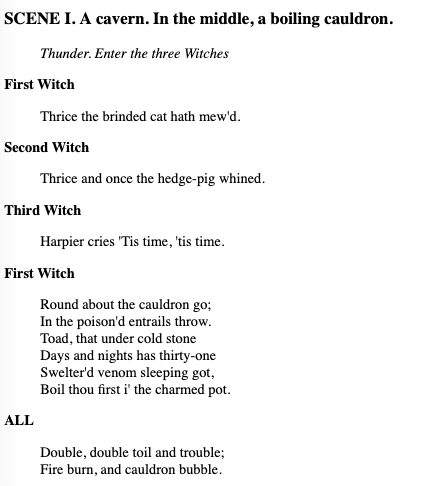
In the opening scene of Macbeth, he witches actually say “Double, double, toil and trouble, / Fire burn and cauldron bubble”  as the refrain of their song about making a potion in the cauldron in the centre of the stage. 

My favourite opening scene among all Shakespeare’s plays, this is a passage that is super cool and super creepy at the same time. Despite the fact that the witches are brewing something potent, the song concludes with a witch declaring that “something wicked comes” when Macbeth enters. It’s a powerful statement of how dark and deadly the central character of the play will turn out to be. 

You can read the entire scene here.

Shakespeare Nerd.

In an attempt to organise all my Shakespeare-related posts so they might actually reach the readers they were written for, I have a new Facebook page called Shakespeare Nerd

It’s easy to find those posts on WordPress because you can search, or simply click on a category like Shakespeare or a tag like Shakespeare Nerd and they will magically appear.

Finding specific posts on Facebook is not that straightforward, and so my new page was born. 

It’s already full of all sorts of hey nonny nonny and hurly burly, and waiting to be discovered by my fellow Shakespeare lovers.

If you are on Facebook, love Shakespeare, and want to make my day, please give it a like. 

If you’re not, or you don’t, or don’t want to, there is absolutely no obligation. You won’t miss a thing, because you’re already here, right at the front of the line waiting for me to serve up the wordy nerdy goods.

Thank you for being a supporter and reading my posts, by the way. It’s very much appreciated.

Misunderstood Shakespeare: “What The Dickens”

Many people assume that “What the dickens?” is a reference to the author Charles Dickens. 

Considering that Shakespeare wrote this expression in ‘The Merry Wives of Windsor’ in 1600 and Charles Dickens was born in 1812, that is entirely impossible. 

Instead, ‘dickens’ is a euphemism for ‘devil’, as is ‘deuce’. When Mrs Page says “I cannot tell what the dickens his name is…” she really means ‘what the devil”.

It’s a more polite way of expressing strength of an idea or emphasising their intent, in this case, that she has no idea of the identity of the person she is being asked about. It’s exactly the same as people saying ‘heck’ instead of hell, ‘gosh’ instead of ‘God’ and ‘jeez’ instead of ‘Jesus’, and is probably  done for the same reason: superstitious avoidance of using religious terms, or “using in vain” the names of religious entities. 

There’s also a chance that, for some folks, old-fashioned good manners may enter into it, too. 

In short, this is a euphemism: an inoffensive word or phrase used to replace an impolite or offensive one. We use euphemism when we talk about “powdering my nose” or “going to see a man about a dog” instead of “going to the bathroom”, or “bathroom” instead of “toilet”.

Like many of Shakespeare’s words and phrases, “what the dickens” has stood the test of time and is still used as a euphemism today.

Misunderstood Shakespeare: “Wherefore art thou Romeo?”

Of all the lines written by Shakespeare, this is possibly the single most misunderstood by a 21st century audience.

While it might be a romantic notion for a lovesick teenager to look out her window— not a balcony, by the way— and wonder where her beloved might be, that’s all it is. That is not what is happening in this scene. 

In early modern English, “wherefore” meant “why”.

Juliet is not asking where Romeo is.  She is asking why, of all the families in Italy, did her new boyfriend have to belong to the family with which hers had been feuding? Why did he have to carry a name that would be an immovable obstacle to them both? 

She goes on to insist “that which we call a rose by any other name would be as sweet”— in other words, it’s not the name that makes someone what they are.  If Romeo were to change his identity, he would still be the same person. What his name is should not matter — what sort of person he is, and the fact that she loves him, is what should determine their compatibility. 

That’s why when you’re waiting for a friend or looking for your dog, it’s incorrect to ask “Wherefore art thou, Buddy?”
It may sound cute, but it will make your Shakespeare-loving friends cringe, at least on the inside. 

‘Measure for Measure’: When Shakespeare is More 21st Century Than You Realise

Written in 1603 or 1604, ‘Measure for Measure’ is a play with enormous relevance to the 21st century. 

As I listened to the play on the BBC’s ‘The Shakespeare Sessions’ podcast yesterday, it struck me just how timely and relevant it is. 

The play features a man named Angelo who, having been left in charge by the Duke, totally abuses his power in the interests of sexual gratification. He tells Isabella he will pardon her brother Claudio, who has been sentenced to death, if she has sex with him. When Isabella refuses and threatens to tell everyone what he has suggested, he simply asks, “Who will believe you?” 

from ‘Measure for Measure’, Act 2, Scene 4

Angelo is clearly relying on his powerful position, and his ability to hold something over her, to get away with sexual abuse and bribery. And he dares to call it “love”, when it is anything but that. He is attempting to romanticise his proposed rape and abuse of power, as abusers so often do. 

This is exactly the kind of behaviour we’ve seen exposed by the #metoo movement. Men abusing their positions of power and pressuring women to give in to them because they have the power to grant what the women need – a job, justice, whatever… and relying on their position to give them more credibility than a woman in a weaker position in society. It really does foreshadow those now infamous words spoken in 2017 by yet another reprehensible character: “And when you’re a star they let you do it. You can do anything.”

Not easily intimidated, Isabella points out that what he is suggesting is exactly the crime for which he has sentenced her brother to death.  His hypocrisy is abundantly obvious to not only Isabella, but also to the audience.   That she calls him out on it demonstrates her integrity and intelligence. Bravo to Isabella for not taking his crap or falling prey to his greasy manipulation. 

Caught in between wanting to save her brother’s life and not wanting to have sex with Angelo, Isabella verbalises the impossibility of her situation in that very poignant and thought-provoking line: “To whom should I complain? Did I tell this, who would believe me?”

Still, even though she understands that what he says is probably true, she neither yields to him or gives up on her brother. Instead, she finds another way to solve her problems and expose the bad behaviour of Angelo.

As suggested in the title, justice is received at the end of the play in the same measure with which it is meted out at the beginning. 

In this, we see a woman standing up for what is right, defending herself, refusing to give in to a man’s manipulation and sexual pressure, and winning. Angelo is punished for his corruption, and Isabella saves both herself and her brother. 

This is a powerful contrast to most of the women in Shakespeare’s other plays, and indeed in the early modern times in which he lived and wrote, few of whom had any real agency or ability to stand up for themselves against the will of men. 

‘Measure for Measure’ is a thought-provoking and entertaining play which demonstrates that while times have changed, the effect of power and position on human nature has not. Even so, it does remind us that evil people can, and should, be resisted, and we should never stop pursuing justice just because it’s difficult to do so. 

That is truly a message pertinent to life in the 21st century. 

Dear Internet: That Quote You Love? It’s Not By Shakespeare.

I wrote a few weeks back about the things I enjoy , and the things I don’t enjoy so much, about Pinterest

Since then, I’ve noticed one really annoying thing when I’ve been scrolling through my feed. It’s not actually the fault of Pinterest, but it is there that I am continually reminded of a matter that really needs to be corrected.

There’s a super popular quote that keeps coming up on my feed because Pinterest knows I love Shakespeare. It’s all over the internet, and it seems every second person on Pinterest is sharing it. 

This quote is the darling of the Internet. But it’s not by Shakespeare.

The problem is, while it sounds like something Shakespeare might have written, those lines do not appear anywhere in the plays or poetry of the Bard… not even close, actually.

The quote is a translation from an Italian opera by Arrigo Boito titled ‘Falstaff’, based on one of Shakespeare’s plays, and which uses a number of lines from several other plays, too. Given that Boito borrowed from the Bard quite freely, it’s not really surprising that other lines from the libretto have been wrongly attributed back to Shakespeare. Some might suggest it’s karma, but it’s really just careless.

I’m more than happy for people to continue posting pretty images of the quote, but it would be great to see them attributed to the right person.  

Too much to hope for?
Yeah… it probably is. 

On Verbing

Most of the time, when people protest about the way the English language is abused, it’s a case of the language continuing to evolve as it has always done.

One such example is the practice of verbing, which takes the noun form of a word and transforms it into a verb form… like ‘verb’ and ‘verbing’. 

Just last week, I was talking with a friend about how annoying she finds it when people say “I’m going to action that.” I’m sure she sought me out for the conversation because I’m both a word nerd and an English teacher. 

“Action is a noun! A bloody noun! How can so many otherwise intelligent people get that wrong?”

“It grates on us because it’s recent,” I said. “We’ll get used to it.”

“No, I won’t! It’s just wrong!”

“You know Shakespeare did it?”

“What?” 

“Verbing. He did it all the time.”

“You and your Shakespeare. It’s like he’s the answer to everything.” 

“You know he invented the word ‘friending’, right?”

She rolled her eyes and walked away. She didn’t even flinch at my use of the term “verbing”, which is exactly the same thing as “actioning” in terms of the language. After all, ‘verb’ is a noun, too. 

It is the recent examples of verbing, such as “actioning” an idea, that we notice because we’re not used to hearing them yet. When Facebook was new, people complained the same way about “friending”, but these days nobody thinks twice about that. At some point in time, someone decided that it was okay to talk about bottling  fruit, or shelving books, and now those terms are just everyday language. 

It is also true, however, that some things people commonly say are, quite simply, wrong

My pet peeve is when my students are talking about sport or some other kind of competition, and they say “We versed Team X”. 

This is a common bastardisation of the Latin versus, which means ‘against’. It is commonly used for sporting matches and legal cases, and is generally abbreviated as v. or vs., as in Black v. White or Blue vs. Red. 

My first response is always to ask whey they wrote poetry about another team. “You played them. You opposed them. You clashed with them. You competed with them. You did not write poetry about them.” Then I explain how the different words work, and what they actually mean. 

The reason “versed” is wrong is because the words ‘versus’ and ‘verse’ have absolutely nothing to do with each other. Because ‘against’ is a preposition, it simply doesn’t make sense to say “We againsted them”. It is not verbing, by any stretch of the imagination. 

The first time we have that conversation, they look at me with confusion. Some have a glazed look of fear, like the proverbial deer caught in the headlights. This never fails to entertain me. The second and third times, they roll their eyes.

Over time, the tedium of having the same grammar-nerdy conversation persuades them to start using the language correctly. They learn, I win, and so does the English language. 

A Favourite Shakespeare Play: ‘Much Ado About Nothing’

Much Ado About Nothing by Alfred Elmore, 1848. Image: Public Domain.

‘Much Ado About Nothing’ was written in 1598-99.  It is one of Shakespeare’s comedy plays, which means that the main characters enjoy a happy ending.  

In that sense, the word ‘comedy’ has changed over time, because now it’s understood to mean a text that is designed to make the audience laugh. There is plenty of humour in this play, though, as it was written purely to entertain and amuse the Elizabethan audiences. 

While it’s all about the entertainment, the play does explore some key ideas in ways that are designed to make the audience consider or contemplate those concepts for themselves. 

The play revolves around the challenges encountered by several couples who are in love but face various challenges in their personal lives that threaten their happiness and wellbeing. The ways in which different people respond to those conflicts and complications are well worth thinking about, because relationships are always challenged by problems of one kind or another. As Shakespeare observed in ‘A Midsummer Night’s Dream’, “the course of true love never did run smooth”, an epithet which is demonstrated with profound clarity in ‘Much Ado’.  

Questions of commitment, trust, belonging, family dysfunction, hatred and revenge all emerge in this play, seamlessly woven into and underpinning the plot and the responses of the characters. 
It is those timeless ideas that enable audience five hundred years later to still appreciate and relate to Shakespeare’s plays even though the language and many elements of our society have evolved since then. Shakespeare really was a master of exploring and portraying human nature at its best and its worst.

In contrast to those more serious ideas, one of the things I enjoy most about this play is the wit and banter between Beatrice and Benedick. They’re crazy about each other, but spend most of their time insulting and taunting each other because neither one knows that other is crazy about the other. In that way, theirs is an unconventional romance because there’s no formality, no swooning, and no overly sentimental conversations. They’re far more likely to be saucy or sarcastic than sickly sweet. 

Dogberry is hilarious in his frequent mangling of the language and the way he continually bungles his job as the constable despite his pretentiousness and high opinion of himself. He is entirely inept and ridiculous, providing some welcome comic relief during the more emotionally intense phase of the play. 

I also enjoy the way in which Shakespeare uses the characters and events of this play to make fun of the stereotypical romances that occurred in many popular plays and stories of the time, adding another level of wit and engagement to this play. I do love a bit of snarky, subversive humour, especially when it comes to the tropes of the genre of romance. 

As with all good Shakespeare plays, there are a couple of characters we can enjoy hating on. Don John, in a perpetual bad mood, seems determined to make everyone else suffer, just because things haven’t always gone his way. His selfish dudgeon may be as annoying to the audience as it is to the rest of the characters, but his blatant disregard for Hero makes him despicable. 

I also harbour significant dislike for Claudio and Leonato because they never even stop to consider that Hero might be innocent of the accusations levelled against her. For two men who love her – albeit in different capacities –  they have a mighty strange way of showing it. They don’t give her any credit for honesty or integrity: instead, they both default to outright condemnation.  The fact that Claudio delivers his judgement with such vengeance puts him right into my “love to hate” group with Don John. 

Finally, I can’t help but love a play that can get so much mileage out of a line like “hey, nonny nonny!” 

A Favourite Shakespeare Play: ‘Macbeth’

Macbeth is a play that has always fascinated people, engaging their superstitions as well as their imaginations. For this reason, its often called The Scottish Play by actors and theatre folk, as it’s believed to be unlucky to say ‘Macbeth’ in a theatre.

It’s a cracker of a story. The supernatural ‘weird sisters’ tell Macbeth he’s going to be Thane of Cawdor, and then tell him he is going to be king. In response, Macbeth does everything in his power to make it happen, only to be haunted by his victims and unable to actually enjoy his success when it does. You really do have to wonder how it would have all worked out if he’d responded with, “That’s nice!” and let things happen as they would. 

Of course, you can’t just blame it all on Macbeth. His wife – whom I like to call Lady Macdeath – plays a significant part in engineering him onto the throne, mostly by bullying him into doing things he doesn’t really want to do.

The play has some fabulous macabre moments— the witches are spooky, their prophecies are uncanny, and you can bet your last dollar you don’t want to eat what they’re cooking in that cauldron. Even better is the part where Banquo’s ghost shows up for dinner shaking his “gory locks”: that is my favourite scene in the whole play.

Laced with suspense, intrigue, and dramatic irony, ‘Macbeth’ keeps the audience hooked to the very end, even though we all know by now how it’s going to work out. There’s more magic than just “Double, double, toil and trouble / Fire burn and cauldron bubble” in this play. 

Strangely enough, reading the text has brought me some odd comfort this weekend as I contemplate the fate of people who manipulate, lie and use others for their own nefarious purposes. I have taken dark satisfaction in seeing those who chose to do evil get what they deserved in the end. It may not be gracious, but it is quite therapeutic to think that maybe the Fates really do have things under control. Sometimes you need to take your catharsis wherever you can get it. 

That, of course, is the genius of all Shakespeare’s plays. He deals in the emotions we all understand – ambition, greed, love, anger, jealousy, pride, and the experience of being at the receiving end of the bad behaviour of others. The language may have changed slightly, but human nature certainly has not. 

Shakespeare doesn’t have to work hard to make the audience dislike Macbeth and his cold-hearted shrew of a wife: we get it. We have all seen people succeed by means of deceiving and manipulating others, or by stabbing someone else in the back, and we don’t like them, either.