Satisfying Shakespearean Ways To Tell Someone To Go Away #4: Avaunt!

Photo by Andrea Piacquadio on Pexels.com

There are times when each of us needs to tell someone to go away. Adding a Shakespearean flavour to it lends both style and emphasis to any ejection of a bothersome person.  It can also deliver a most satisfying sense of accomplishment to lovers of Shakespeare or of language in general.

The Problem of Female Agency in Shakespeare’s ‘The Taming of the Shrew’
#women #Shakespeare #ShakespeareSunday

Avaunt definitely carries spiritual or superstitious weight. This is the word one would use for commanding demons, witches and any other evil presence to leave. When directed at people rather than the supernatural, it carries connotations of derision, hatred, or fear; that the speaker seeks to protect themselves from those to whom they speak is clearly evident.

In The Comedy of Errors, Act 4, Scene 3, we see Antipholus and Dromio discussing the courtesan who has just demanded gold from Antipholus.

COURTESAN
Well met, well met, Master Antipholus. I see, sir, you have found the goldsmith now. Is that the chain you promis’d me today?

ANTIPHOLUS
Satan, avoid, I charge thee tempt me not.

DROMIO
Master, is this Mistress Satan?

ANTIPHOLUS
It is the devil.

DROMIO
Nay, she is worse, she is the devil’s dam, and here she comes in the habit of a light wench; and thereof comes that the wenches say, “God damn me,” that’s as much to say, “God make me a light wench.” It is written, they appear to men like angels of light, light is an effect of fire, and fire will burn: ergo, light  wenches will burn. Come not near her.

When the lady asks again for either the promised gold chain or the return of her ring, Antipholus uses avaunt to send her away, emphasising the spiritual or supernatural  theme of his earlier judgement upon her.

COURTESAN
I pray you, sir, my ring, or else the chain;I hope you do not mean to cheat me so?

ANTIPHOLUS
Avaunt, thou witch! Come, Dromio, let us go.

The Problem of Female Agency in Shakespeare’s ‘The Taming of the Shrew’
#women #Shakespeare #ShakespeareSunday

Othello uses the word twice. First, In the course of Iago’s subtle and insidious destruction of Othello’s belief in Desdemona’s innocence, Othello tells Iago, ‘Avaunt, be gone! Thou hast set me on the rack.”

Later, he uses the term in the presence of Lodovico to dismiss Desdemona once he has finished accusing her of being false and mocking her distress at his treatment of her. Here, he speaks to Lodovico and Desdemona alternately in the one speech.

Sir, she can turn, and turn; and yet go on
And turn again; and she can weep, sir, weep;
And she’s obedient, as you say, obedient;
Very obedient Proceed you in your tears
Concerning this, sir O well-painted passion!
I am commanded home. Get you away;
I’ll send for you anon. Sir, I obey the mandate,
And will return to Venice. Hence, avaunt!

Exit Desdemona.

Othello speaks politely to Lodovico while simultaneously disrespecting Desdemona. The tone of Othello’s words to his wife is very similar to that used by Antipholus, demonstrating the contempt and moral heft of the dismissal. At this point, it is clear that there is no going back for Othello: he has made up his mind, and his love and respect for her are dead.

The Problem of Female Agency in Shakespeare’s ‘The Taming of the Shrew’
#women #Shakespeare #ShakespeareSunday


In Macbeth, Act 3 Scene 4, Macbeth is shaken by the appearance at dinner of Banquo’s ghost, which he addresses thus:

Avaunt, and quit my sight! Let the earth hide thee!
Thy bones are marrowless, thy blood is cold;
Thou hast no speculation in those eyes
Which thou dost glare with!

In that powerful second scene of Richard III in which Richard woos Anne Neville and begs her to marry him, Anne responds to Richard’s interruption of the funeral procession of the former King Henry VI with words and tone of superstition and the supernatural:

GLOUCESTER
Stay, you that bear the corse, and set it down.

ANNE
What black magician conjures up this fiend
To stop devoted charitable deeds?

GLOUCESTER
Villain, set down the corse, or, by Saint Paul,
I’ll make a corse of him that disobeys.

GENTLEMAN
My lord, stand back, and let the coffin pass.

GLOUCESTER
Unmanner’d dog, stand thou when I command.
Advance thy halberd higher than my breast,
Or by Saint Paull Ill strike thee to m foot,
And spurn on thee, beggar, for thy boldness.

ANNE
What, do you tremble? Are you all afraid?
Alas, I blame you not, for you are mortal.
And mortal eyes cannot endure the devil.
Avaunt, thou dreadful minister of hell!
Thou hadst but power over his mortal body,
His soul thou canst not have. Therefore be gone.

The exchange that follows is full of the imagery of saints and devils, angels and demons, and heaven and hell.

In both these instances, the supernatural context of the use of avaunt! demonstrates the seriousness and spiritual gravity with which it was spoken. It was the word used to command sinners rather than saints and fiends rather than friends.

Shakespearean Ways To Tell Someone To Go Away: Avaunt!
#Shakespeare #language #howto

Shakespeare’s Baubles.


Because it’s December and Christmas decorations are everywhere, I wrote last night about the meanings and etymology of the word ‘bauble’ on WordyNerdBird. I wondered then if it were a word used by Shakespeare. To my delight, it was indeed!

Interestingly, Shakespeare references one of the continued senses and the obsolete sense of the word, and creates double entendre with it for extra credit.

In ‘Cymbeline’, the queen refers to Caesar’s ships bobbing around on the sea as ‘ignorant baubles’, describing them further as being like egg shells, being thrown and broken against the rocks.

A similar reference to boats as ‘baubles’ is made in ‘Troilus and Cressida.

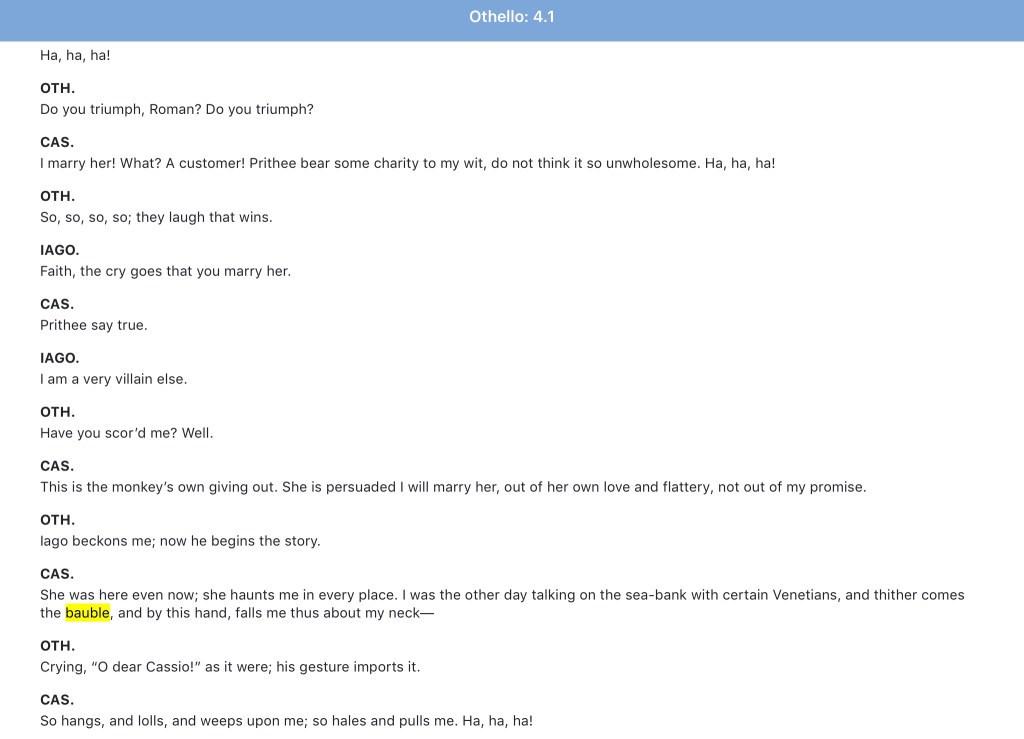
In ‘Othello’, Cassio shows his disregard for Bianca by describing her as a bauble that follows him around and tries to make him fall in love with her.  That his companions laugh with him demonstrates that this use of the word to describe a pretty but not-so-valuable woman was easily understood at the time.

In ‘The Taming of the Shrew’, ‘bauble’ is used to refer to Kate’s hat – a decorative item of clothing, which is of little value in the play other than its use as a prop in her surprising demonstration of obedience to her husband, Petruchio.

‘Timon of Athens’ references a bauble as the staff of a jester or idiot, although in this instance, Aaron the Moor is suggesting that a king holding his sceptre and claiming to be faithful to God is the equivalent of his fool holding a bauble and pretending to be the king.

This sense of ‘bauble’ is extended in All’s Well That Ends Well, where the Clown refers to cheating on a man with his wife and giving her his bauble “to do her service”.  Clearly, this is a pun on the jester’s staff, used to reference an altogether different kind of rod with a special ending on it.

This is Shakespeare’s trademark wit in action, taking common language and creating word play loaded with double entendre that would delight the masses and the ‘gentlemen’ alike.

“Thou art too malapert…”

Peacock malapert know-it-all overconfident showy
Image from PublicDomainPictures on Pixabay

Malapert refers to a person who acts like they know everything and is confident that they are always right. 

While there are a number of characters in Shakespeare’s works whom we might consider to be malapert, Shakespeare uses the word only three times in his plays.

In Henry 6, Queen Margaret and her son, the young Lancaster Prince Edward, engage in a contest of insults with their captors: Clarence and Gloucester. As sons of Richard, Duke of York these two are the Lancastrian King Henry’s enemies, as the two houses are rivals for the English throne. Clarence calls the young prince malapert, highlighting his youthful confidence by calling him an “untutor’d lad”. 

Almost as proof of Clarence’s assessment, the prince responds by insulting them again. Despite the clevernesand bravery of his words, this proved to be a bad move, as “perjur’d George” and “misshapen Dick” respond by stabbing him to death. End of argument. 

In Richard III, the same Queen Margaret tells the Marquess of Dorset that he is malapert and warns him that his newly found nobility won’t protect him from being destroyed by the Yorks, particularly Richard (Gloucester) whom  she describes as a “bottled spider” and a “poisonous bunch-back’d toad”. Richard turns the insult back on Margaret, and Dorset promptly turns it right back on him. 

In the comedy Twelfth Night, Sir Toby Belch and Sebastian are engaged in an argument when Sir Toby insists that he “must have an ounce or two of this malapert blood” from his rival. 

Malapert
#words #Shakespeare #ShakespeareSunday

Misunderstood Shakespeare: “What The Dickens”

Many people assume that “What the dickens?” is a reference to the author Charles Dickens. 

Considering that Shakespeare wrote this expression in ‘The Merry Wives of Windsor’ in 1600 and Charles Dickens was born in 1812, that is entirely impossible. 

Instead, ‘dickens’ is a euphemism for ‘devil’, as is ‘deuce’. When Mrs Page says “I cannot tell what the dickens his name is…” she really means ‘what the devil”.

It’s a more polite way of expressing strength of an idea or emphasising their intent, in this case, that she has no idea of the identity of the person she is being asked about. It’s exactly the same as people saying ‘heck’ instead of hell, ‘gosh’ instead of ‘God’ and ‘jeez’ instead of ‘Jesus’, and is probably  done for the same reason: superstitious avoidance of using religious terms, or “using in vain” the names of religious entities. 

There’s also a chance that, for some folks, old-fashioned good manners may enter into it, too. 

In short, this is a euphemism: an inoffensive word or phrase used to replace an impolite or offensive one. We use euphemism when we talk about “powdering my nose” or “going to see a man about a dog” instead of “going to the bathroom”, or “bathroom” instead of “toilet”.

Like many of Shakespeare’s words and phrases, “what the dickens” has stood the test of time and is still used as a euphemism today.

On Verbing

Most of the time, when people protest about the way the English language is abused, it’s a case of the language continuing to evolve as it has always done.

One such example is the practice of verbing, which takes the noun form of a word and transforms it into a verb form… like ‘verb’ and ‘verbing’. 

Just last week, I was talking with a friend about how annoying she finds it when people say “I’m going to action that.” I’m sure she sought me out for the conversation because I’m both a word nerd and an English teacher. 

“Action is a noun! A bloody noun! How can so many otherwise intelligent people get that wrong?”

“It grates on us because it’s recent,” I said. “We’ll get used to it.”

“No, I won’t! It’s just wrong!”

“You know Shakespeare did it?”

“What?” 

“Verbing. He did it all the time.”

“You and your Shakespeare. It’s like he’s the answer to everything.” 

“You know he invented the word ‘friending’, right?”

She rolled her eyes and walked away. She didn’t even flinch at my use of the term “verbing”, which is exactly the same thing as “actioning” in terms of the language. After all, ‘verb’ is a noun, too. 

It is the recent examples of verbing, such as “actioning” an idea, that we notice because we’re not used to hearing them yet. When Facebook was new, people complained the same way about “friending”, but these days nobody thinks twice about that. At some point in time, someone decided that it was okay to talk about bottling  fruit, or shelving books, and now those terms are just everyday language. 

It is also true, however, that some things people commonly say are, quite simply, wrong

My pet peeve is when my students are talking about sport or some other kind of competition, and they say “We versed Team X”. 

This is a common bastardisation of the Latin versus, which means ‘against’. It is commonly used for sporting matches and legal cases, and is generally abbreviated as v. or vs., as in Black v. White or Blue vs. Red. 

My first response is always to ask whey they wrote poetry about another team. “You played them. You opposed them. You clashed with them. You competed with them. You did not write poetry about them.” Then I explain how the different words work, and what they actually mean. 

The reason “versed” is wrong is because the words ‘versus’ and ‘verse’ have absolutely nothing to do with each other. Because ‘against’ is a preposition, it simply doesn’t make sense to say “We againsted them”. It is not verbing, by any stretch of the imagination. 

The first time we have that conversation, they look at me with confusion. Some have a glazed look of fear, like the proverbial deer caught in the headlights. This never fails to entertain me. The second and third times, they roll their eyes.

Over time, the tedium of having the same grammar-nerdy conversation persuades them to start using the language correctly. They learn, I win, and so does the English language. 

Hey nonny nonny

‘Hey nonny nonny’ is a curious little phrase found in Shakespeare’s ‘Much Ado About Nothing’. The character Balthasar sings a song to the ladies in which he recommends that instead of worrying about what the men are up to, they should convert their sighs of despair into ‘hey nonny nonny’.

The phrase ‘Hey nonny nonny’ has no direct translation into modern English, but is understood from the context that it could be taken to mean a dismissal of circumstances as we do today with expressions like “whatever”, “what the heck?” or “that’s life”, or simply refer to general merry-making. 

As such, it is a phrase that can be safely used in circumstances where less appropriate responses cannot be uttered. In my experience, expressing one’s umbrage using Shakespearean quotations is almost as satisfying as actually swearing anyway. There is something remarkably cathartic about speaking in Elizabethan English, although that will likely never be understood by anyone who does not appreciate and enjoy the language as I do. 

I have decided to add “hey nonny nonny” into my repertoire as a worthy companion exclamation to my renowned-among-those-who-know-me question, “What manner of nitwittery shall plague me on the morrow?”
In writing this post, however, I’ve come to one realisation: I will have to teach my devices that I intend to type “hey sonny sonny” or “hey nanny nanny” about as much as I ever mean to type “oh shot”. 

Hey, nonny nonny. They’ll learn.