Birthday.

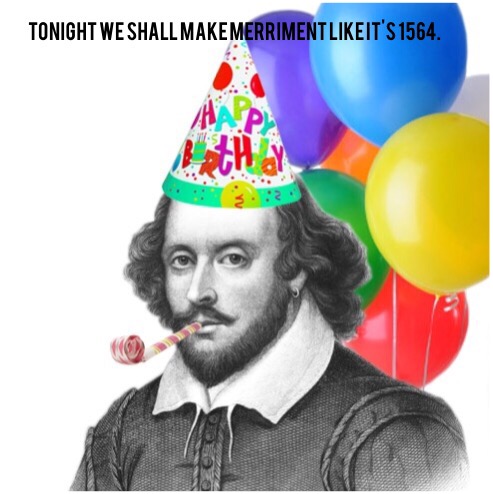
April 23 is the date upon which we assume Shakespeare was born

Happy birthday, old chap!

The word birthday dates back to the late 14th century, having come from the Old English word byrddæg which meant the anniversary or celebration of one’s birth. At that time, though, it was usually used to commemorate the birth of s very important people, such as kings or saints. It was far more important to those early modern people that their children were christened, and that was the date recorded by the church. Regular folk did not commonly speak of the day on which they were born as their birthday until the 1570s, and about fifty years later they also spoke of their birthnight. 

Even though his own birthdate was not actually recorded, observation of one’s own birthday was far more commonplace by Shakespeare’s time. 

Cleopatra acknowledges her own birthday in Antony and Cleopatra: “It is my birthday: / I had thought t’have held it poor; but since my lord / Is Antony again, I will be Cleopatra.”

The Roman senator Cassius says in Julius Caesar V.i: “This is my birthday; as this very day / Was Cassius born.” 

In Pericles II.i the first of three fishermen with whom Pericles discusses the king, Simonides, observes that it the king “hath a fair daughter, and tomorrow is her birthday, and there are princes and knights come from all parts of the world to joust and tourney for her love.” 
Photo by Maria Pop on Pexels.com

These instances show that celebrating or at least making note of one’s own birthday was something understood by the regular folk who made up most of Shakespeare’s audiences in the late 1590s and early 1600s.

Sources:
Etymonline
Etymologeek

The Problem of Female Agency in Shakespeare’s ‘The Taming of the Shrew’
#women #Shakespeare #ShakespeareSunday

Shakespeare’s Birthday
#ShakespearesBirthday #Shakespeare #blog

A Butt-load of Butts

A butt-load has long been one of my favourite ways ton refer to a large amount, either physically or a figuratively—  one might have a buttload of work, or have to carry or store a buttload of stuff. It amuses me, though, that butt-load can actually refer to an actual unit of measurement.

A butt is a large barrel for wine or spirits that holds roughly four times the size of a regular barrel or two hogsheads Butt came into English in the late 14th century from the Old French word bot  which was the word for a barrel or wine-skin. This came from the late Latin buttis which also meant cask.

Photo by ELEVATE on Pexels.com

The butt used to be a legal measurement, but because the actual size and capacity tended to vary quite a bit — it could be anywhere between 108 and 140 gallons— it fell out of favour.

In Shakespeare’s ‘Richard III’, the Duke of Clarence is drowned in a butt of malmsey wine. In terms of  methods of execution, there are probably worse ways to go. Still, the references to the malmsey- butt never fail to make my students laugh.

This sense of the word is also used in ‘The Tempest’ where Stephano claims to have escaped the storm by floating “upon a butt of sack which the sailors heaved o’erboard”.

That’s because butt canalso mean one’s buttocks: the behind, the rump, the posterior. It first took this meaning from  animal parts in the mid 15th century in relation to butchering and cookery, as a shortened form of buttocks, which was the name given to the meaty rear end of animals and people by about 1300. The application of butt to humans  came later, as part of American slang in the mid 19th century.

Photo by Anna Shvets on Pexels.com

Butt came to mean the the thick end of something or the extremity of a piece of land by about 1400, which is most likely how the term came to be used for the end of a rifle, and therefore a pistol, or of a smoked cigar or cigarette, which was first recorded in 1847.

Photo by Lachlan Ross on Pexels.com

Shakespeare’s Richard III uses this sense of the word when he responds to his mother’s invocation to “put meekness in thy breast,  Love,charity, obedience and true duty”  with “and make me die a good old man! This is the butt-end of a mother’s blessing— / I marvel that Her Grace did leave it out!” This is also a pun for butt as in his being on the receiving end of  her insult.

By the early 1600s, butt had come to be used for the target of a joke or an object of ridicule. 1610s. This was derived from the Old French word but  which meant an aim, goal, end, or a target in archery, which swans in turn the product of the Old French words bot for end and but for aim or goal which was used for a target for shooting practice or a turf-covered mound against which an archery target was set that dated to the mid 1300s.

Photo by Kampus Production on Pexels.com

It is this earlier sense of the word used by Richard, Duke of York in ‘Henry VI part 3’ when he tells his killer, “Come, bloody Clifford, rough Northumberland, I dare your quench.ess fury to more rage. / I am your butt, and I abide your shot.”

Othello also uses sense of this word in his final scene, where he says, “Be thou not afraid, though you do see me weapon’d; / Here is y journey’s end, here is my butt.”

The verb to butt meaning to hit with the head, as a goat, a fighter or a soccer-player might do, was in use by 1200 . This came from Anglo-French buter and Old French boter which meant to push, shove, thrust or knock. This came from either Frankish or another Germanic source which traces back to Proto-Germanic word butan, and before that to the PIE root *bhau which meant to strike.

Photo by Pixabay on Pexels.com

In the banter between Katherine and Longaville‘Love’s Labours Lost’  V.ii, he admonishes  her: “Look how you butt yourself with these sharp mocks, Wilt thou give horns, chaste lady? Do not so.” Katherine responds with a comment about he should die a calf before his horns grow, which is a witty little bit of innuendo as they part ways.

Another example of Shakespeare’s word play is the pun on butt in ‘The Taming of the Shrew’ where Gremio describes the clash of wits between Hortensio and Petruchio thus:  “Believe me, sir, they butt together well.” Bianca responds with both pun and innuendo: “Head and butt! A hasty-witted body / Would say your ‘head and butt’ were ‘head and horn.”

While it may be tempting to think that Doctor Butts, the court physician in Shakespeare’s Henry VIII is another example of delightful word play, that was actually the name of the historical figure. Dr William Butts was the royal doctor in the court of Henry VIII. He was not the only well known member of his family: he came from a family of prominent Butts.
(I’m not even sorry. Sometimes the jokes just write themselves.)

Sources:

Etymonline
Macquarie Dictionary
ShakespeareandHistory.com

The Problem of Female Agency in Shakespeare’s ‘The Taming of the Shrew’
#women #Shakespeare #ShakespeareSunday

A Butt-load of Butts.
#Shakespeare #language

Shakespeare Nerd: Valentine’s Day Edition

This Valentine’s Day edition of Shakespeare Nerd is brought to you by the brilliant Mya Gosling, creator of Good Tickle Brain.

Image reproduced here with permission.

Shakespeare Nerd Valentine’s Day Edition via @goodticklebrain
#ShakespeareSunday #ValentinesDay

“Thou art too malapert…”

Peacock malapert know-it-all overconfident showy
Image from PublicDomainPictures on Pixabay

Malapert refers to a person who acts like they know everything and is confident that they are always right. 

While there are a number of characters in Shakespeare’s works whom we might consider to be malapert, Shakespeare uses the word only three times in his plays.

In Henry 6, Queen Margaret and her son, the young Lancaster Prince Edward, engage in a contest of insults with their captors: Clarence and Gloucester. As sons of Richard, Duke of York these two are the Lancastrian King Henry’s enemies, as the two houses are rivals for the English throne. Clarence calls the young prince malapert, highlighting his youthful confidence by calling him an “untutor’d lad”. 

Almost as proof of Clarence’s assessment, the prince responds by insulting them again. Despite the clevernesand bravery of his words, this proved to be a bad move, as “perjur’d George” and “misshapen Dick” respond by stabbing him to death. End of argument. 

In Richard III, the same Queen Margaret tells the Marquess of Dorset that he is malapert and warns him that his newly found nobility won’t protect him from being destroyed by the Yorks, particularly Richard (Gloucester) whom  she describes as a “bottled spider” and a “poisonous bunch-back’d toad”. Richard turns the insult back on Margaret, and Dorset promptly turns it right back on him. 

In the comedy Twelfth Night, Sir Toby Belch and Sebastian are engaged in an argument when Sir Toby insists that he “must have an ounce or two of this malapert blood” from his rival. 

Malapert
#words #Shakespeare #ShakespeareSunday

Desdemona’s Lament

Photo by Kaboompics .com on Pexels.com

Often when I see a willow tree, I think of the  desperately sad song sung by Ophelia as she prepares for bed in Act 4, scene 3 of ‘Othello’.

‘Willow’ is a folk song that tells of lost love and resulting tragedy, although Ophelia doesn’t quite get that far in the song before she stops to talk with her maid, Emilia. The song was not written by Shakespeare, and it seems to have been widely enough known for the audience to have understood the gravity and foreboding of it being sung by Ophelia. 

Shakespeare did, however, make one significant change. The original song was about a man dying as the result of the cruelty of a woman, but when Ophelia sings it, the song is about a woman suffering at the hands of the man she loves. 

The poignancy of the song is heightened by Ophelia’s revelation to Emilia that her mother’s maid, from whom she learned the song, died tragically while singing it. 


The song takes another tragic twist when Emilia herself sings the song as she, too, dies from injuries inflicted by her own husband. 

Shakespeare uses this song to evoke pathos,  tragedy and foreboding in abundance. 

It seems to me that he willow tree, graceful and mournful at the same time, is a most fitting image for achieving that effect.


Desdemona’s Lament.
#Shakespeare #Othello #willow #tragedy #ShakesepeareNerd #blogpost

Knowing Your Literary Devices.

Knowing the literary devices used by Shakespeare and how they work helps those who read or study his works understand the ways in which he has shaped and crafted meaning in the lines delivered by his characters and in his poetry. It also helps readers to recognise the difference between literal and figurative language, and therefore to interpret more correctly the message of particular lines and scenes, and of texts as a whole. 

Of course, there are the standard ones that everyone should learn in school: simile, metaphor, alliteration, repetition hyperbole.  In senior high, that should extend to more sophisticated devices specific to the text being studied. My senior English class is studying ‘RichardIII’, so they are learning about stichomythia, anaphora and antithesis among others. Irony and dramatic irony are also heavy hitters in this play, so while they are by no means new concepts to the students, we are discussing them in detail. 

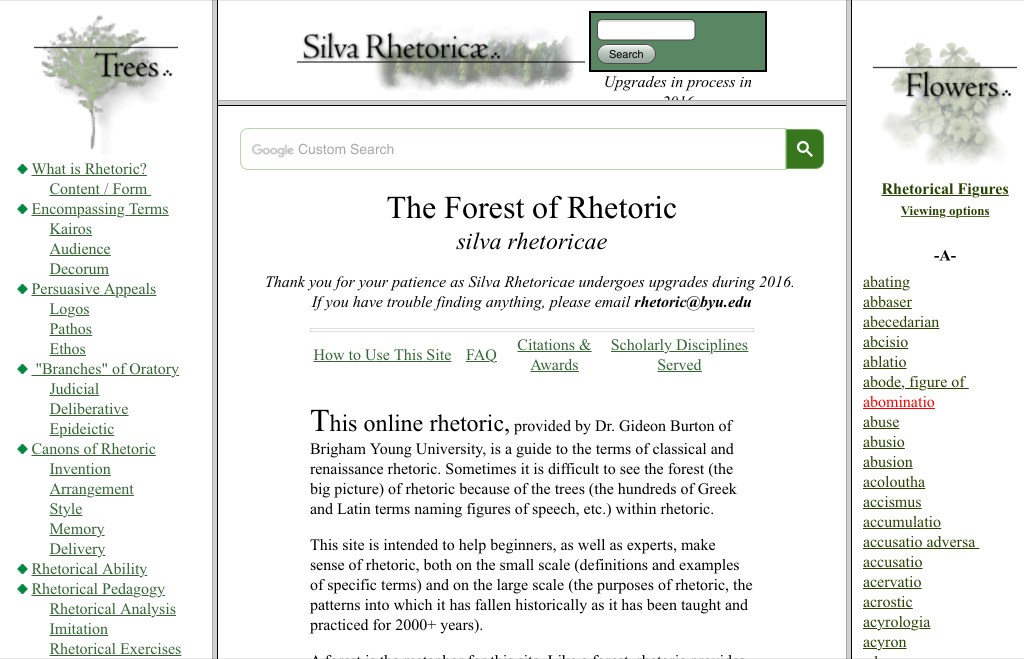
An excellent online resource for the definition and demonstration of rhetorical devices used by Shakespeare and many other dramatists, orators and writers is Silva Rhetoricæ.

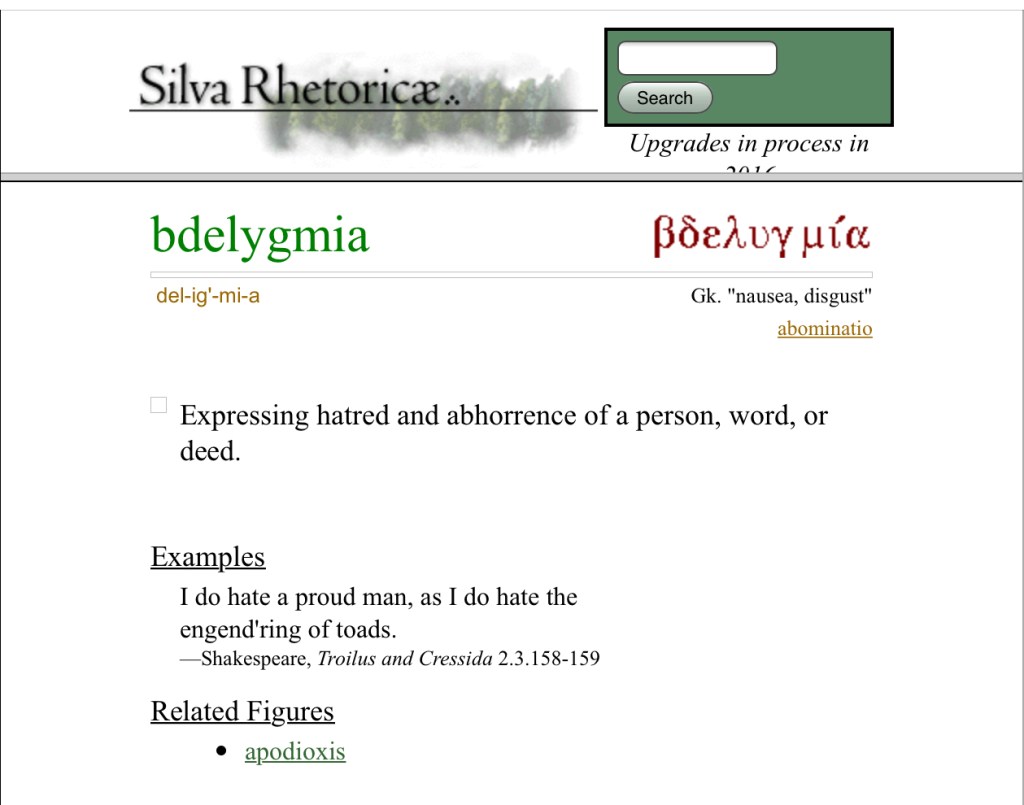
The site is knowledgeable and fairly thorough, although some terms relating to Shakespeare’s plays are not included. The names of rhetorical devices are listed alphabetically, and the definitions are written in plain English with examples and alternative terms provided. There is also a handy pronunciation guide, which is really helpful when it comes to terms like ‘bdelygmia’ and ‘symploce’. 

While I do not expect my students to use the same degree of metalanguage that university students might use, there is definitely credit in nailing the key terms and using them to write about a text with greater eloquence and sophistication. 

Horror Scenes in Shakespeare: Titus Andronicus Cooks Dinner

While Shakespeare isn’t renowned for writing horror, he certainly understood the power of a macabre scene and the dramatic impact of horror when portraying just how evil a character could be. 
He created a number of beautifully creepy and macabre scenes that hold definite appeal for horror fans, and which make great reading for October and Halloween. 

The Problem of Female Agency in Shakespeare’s ‘The Taming of the Shrew’
#women #Shakespeare #ShakespeareSunday

Titus Andronicus is a confronting play. The story is full of enmity and revenge, a lot of violence, and a truckload of bloodshed and murder, with most of that happening on stage. It may already sound like a splatter horror storyline, but the final scene is particularly horrific.

Titus Andronicus is a Roman general who loses all but four of his sons in a war against the Goths, during which he has captured their queen, Tamora, her three sons and Aaron, a Moor, among others. Titus slays Tamora’s eldest son in a ritual killing to honour his dead sons, causing Tamora to swear hatred and revenge against him. 

She isn’t kidding. Having married the Emperor Saturninus, Tamora has two of Titus’ four remaining sons framed for the murder of the Emperor’s brother — a crime committed by her own sons, Chiron and Demetrius — for which they are beheaded. Then she has her sons rape Titus’ daughter Livinia, cut off her hands and cut out her tongue so that she can’t tell anyone what they’ve done. 

Titus feigns madness, ostensibly brought on by grief, until Tamora, trying to take advantage of his insanity, tries to make a deal with him. Titus isn’t falling for that, though: he wants revenge, and he intends that Tamora will suffer far more than he has done. Keeping up his ruse, he invites Tamora, Saturninus, and various others to a banquet in Rome’s honour.

In Act 5, Scene 3, Titus proves that he is a master of revenge, and Shakespeare proves that he is a master of the macabre.

In this scene, Titus himself serves dinner and  encourages everyone to eat heartily of the feast. 

He proceeds to kill his daughter Livinia in front of the guests and tells Tamora it’s actually her sons that killed her through their despicable actions. When Saturninus demands that they are called to answer for their actions, Titus reveals that they’re already there— they’ve been baked into the pie that Tamora and everyone else just ate for dinner. 

At that point, the bloodshed starts again in full earnest. 

Titus stabs Tamora to death with a knife. 
Saturninus kills Titus. 
Titus’ son Lucius kills Saturninus. 

Lucius and Marcus, Titus’ other remaining son, expose the crimes of Tamora’s sons. They also expose Tamora’s love child to Aaron, the Moor who was  captured by Titus at the same time as she was.  Lucius and Marcus then invite the people of Rome to judge them for their deeds in avenging their brother and father. Instead of punishing them, the Romans make Lucius the new Emperor.

Aaron is buried alive, breast deep, so that he can regret his actions while starving to death. The Romans are forbidden to feed or help him. 

Tamora is denied a funeral, and her body is thrown to the wild beasts and birds of prey.

This scene alone has seven murders, four of which are brutally violent and take place on stage, and one live burial. 

You can read the rest of the scene, or the whole play, here.

The Problem of Female Agency in Shakespeare’s ‘The Taming of the Shrew’
#women #Shakespeare #ShakespeareSunday

William Shakespeare: writing splatter horror four hundred years before it became popular.  
You’re welcome. 

Shakespeare Annotated: John Milton’s First Folio

John Milton – portrait attributed to Godfrey Kneller. Image: Public Domain.

This is a fascinating discovery!

A copy of the First Folio has been proven to have been annotated in John Milton’s own handwriting.

Read more about it at The Shakespeare Blog’s article titled Shakespeare annotated: John Milton’s First Folio

Horror Scenes in Shakespeare: The Witches in ‘Macbeth’

While Shakespeare isn’t renowned for writing horror, he certainly understood the power of a macabre scene and the dramatic impact of horror when portraying just how evil a character could be. 
He created a number of beautifully creepy and macabre scenes that hold definite appeal for horror fans, and which make great reading for October and Halloween. 

Often referred to as the Weird Sisters, the witches of ‘Macbeth’ open the play with a powerfully macabre and horrifying scene. There is a cauldron in the middle of the cavern, around which the witches dance and recite the list of ingredients in the potion they are making. 

Just reading the recipe is enough to make one’s skin crawl – and we are nowhere near as superstitious as Shakespeare’s original audiences. 

In 1606 when the play is thought to have first been performed, audiences then would have both living memory and current knowledge of witch trials and persecutions, and would have been very wary of anything to do with witches and magic.

Shakespeare knew what we was doing, though. James I had been king of England for a few years, and  did not enjoy universal popularity among his English subjects. By portraying the witches and Macbeth as evil, he was making a powerful statement about anyone who tried to depose a Scottish king who held the throne legally and rightfully. 

So, the witches dance and sing, and Macbeth subscribes to everything they suggest about his own future, even though he first acknowledges them as “black and midnight hags”. Thus begins the dark drama of ‘Macbeth’, the Scottish play.

The Problem of Female Agency in Shakespeare’s ‘The Taming of the Shrew’
#women #Shakespeare #ShakespeareSunday

SCENE I. A cavern. In the middle, a boiling cauldron.

Thunder. Enter the three Witches

First Witch
Thrice the brinded cat hath mew’d.

Second Witch
Thrice and once the hedge-pig whined.

Third Witch
Harpier cries ‘Tis time, ’tis time.

First Witch
Round about the cauldron go;
In the poison’d entrails throw.
Toad, that under cold stone
Days and nights has thirty-one
Swelter’d venom sleeping got,
Boil thou first i’ the charmed pot.

ALL
Double, double toil and trouble;
Fire burn, and cauldron bubble.

Second Witch
Fillet of a fenny snake, I
n the cauldron boil and bake;
Eye of newt and toe of frog,
Wool of bat and tongue of dog,
Adder’s fork and blind-worm’s sting,
Lizard’s leg and owlet’s wing,
For a charm of powerful trouble,
Like a hell-broth boil and bubble.

ALL
Double, double toil and trouble;
Fire burn and cauldron bubble.

Third Witch
Scale of dragon, tooth of wolf,
Witches’ mummy, maw and gulf
Of the ravin’d salt-sea shark,
Root of hemlock digg’d i’ the dark,
Liver of blaspheming Jew,
Gall of goat, and slips of yew
Silver’d in the moon’s eclipse,
Nose of Turk and Tartar’s lips,
Finger of birth-strangled babe
Ditch-deliver’d by a drab,
Make the gruel thick and slab:
Add thereto a tiger’s chaudron,
For the ingredients of our cauldron.

ALL
Double, double toil and trouble;
Fire burn and cauldron bubble.

Second Witch
Cool it with a baboon’s blood,
Then the charm is firm and good.

Enter HECATE to the other three Witches

HECATE
O well done! I commend your pains;
And every one shall share i’ the gains;
And now about the cauldron sing,
Live elves and fairies in a ring,
Enchanting all that you put in.

Music and a song: ‘Black spirits,’ & c
HECATE retires

Second Witch
By the pricking of my thumbs,
Something wicked this way comes.
Open, locks, Whoever knocks!

Enter MACBETH

MACBETH
How now, you secret, black, and midnight hags! What is’t you do?

Read the rest of the scene, or the whole play, here.