Shakespearean Ways To Tell Someone To Go Away: Get Thee Gone!

Photo by Andrea Piacquadio on Pexels.com

There are times when each of us needs to tell someone to go away. Adding a Shakespearean flavour to it lends both style and emphasis to any ejection of a bothersome person. It can also deliver a most satisfying sense of accomplishment to lovers of Shakespeare or of language in general.

The Problem of Female Agency in Shakespeare’s ‘The Taming of the Shrew’
#women #Shakespeare #ShakespeareSunday

Begone is the base level entreaty for someone to leave. To say “Fellow, begone!” is the equivalent of “Okay mate, out you go…” today. If not addressing someone who is actually a fellow, you can use any other form of address, or simply say “Begone!” with an imperative tone. A flick of the hand toward the door could add a nice dramatic touch.

Get thee gone! adds a touch of urgency. It’s more like saying “Go, quickly!” or “Get out now!” This is used forty times throughout Shakespeare’s plays, usually when there is a sense of timeliness or hurry about the leaving. It can also suggest impatience or frustration with the person to whom the command is addressed.

In Henry IV part 1, Act 1 Scene 3, King Henry addresses Worcester thus:”Worcester, get thee gone, for I do seeDanger and disobedience in thine eye.”

In Act 3, Scene 1 of Timon of Athens, the grief-stricken Timon tells Alcibiades he wants to be left alone with the command “I prithee, beat thy drum and get thee gone.” This is a reference to the military practice of beating a particular rhythm for retreat, making it the Elizabethan equivalent of “beat it!”

In different parts of Henry 6 , we see Margaret of Anjou use Get thee gone in two different ways.

In part 2, Act 3 Scene 2, Margaret of Anjou farewells the Duke of Suffolk with an impassioned speech:
“O. let me entreat thee cease. Give me thy hand,
That I may dew it with my mournful tears;
Nor let the rain of heaven wet this place
To wash away my woeful monuments.
O, could this kiss be printed in thy hand.
That thou might think upon these by the seal,
Through whom a thousand sighs are breath’d for thee!
So get thee gone, that I may know my grief,
‘Tis but surmised whiles thou art standing by,
As one that surfeits thinking on a want.
I will repeal thee, or, be well assur’d,
Adventure to be banished myself;
And banished I am, if but from thee.
Go, speak not to me; even now be gone.”

In Act 3, Scene 6 of Henry 6  part 3, Margaret is far less heartbroken to be bidding her husband, King Henry VI, farewell. Furious and resentful at the amount of power he has given to his councillors– and her enemies– Warwick, Faulconbridge and York, Margaret announces her intention to summon her army and go to war with them. Henry begs her to “Stay, gentle Margaret, and let me speak.”
Her response is curt: “Thou has spoke too much already; get thee gone.”

Yet again, Shakespeare’s Margaret demonstrates that elementary truth: tone really is everything.

The Problem of Female Agency in Shakespeare’s ‘The Taming of the Shrew’
#women #Shakespeare #ShakespeareSunday

Shakesepearean Ways To Tell Someone To Go Away
#Shakespeare #words

A Butt-load of Butts

A butt-load has long been one of my favourite ways ton refer to a large amount, either physically or a figuratively—  one might have a buttload of work, or have to carry or store a buttload of stuff. It amuses me, though, that butt-load can actually refer to an actual unit of measurement.

A butt is a large barrel for wine or spirits that holds roughly four times the size of a regular barrel or two hogsheads Butt came into English in the late 14th century from the Old French word bot  which was the word for a barrel or wine-skin. This came from the late Latin buttis which also meant cask.

Photo by ELEVATE on Pexels.com

The butt used to be a legal measurement, but because the actual size and capacity tended to vary quite a bit — it could be anywhere between 108 and 140 gallons— it fell out of favour.

In Shakespeare’s ‘Richard III’, the Duke of Clarence is drowned in a butt of malmsey wine. In terms of  methods of execution, there are probably worse ways to go. Still, the references to the malmsey- butt never fail to make my students laugh.

This sense of the word is also used in ‘The Tempest’ where Stephano claims to have escaped the storm by floating “upon a butt of sack which the sailors heaved o’erboard”.

That’s because butt canalso mean one’s buttocks: the behind, the rump, the posterior. It first took this meaning from  animal parts in the mid 15th century in relation to butchering and cookery, as a shortened form of buttocks, which was the name given to the meaty rear end of animals and people by about 1300. The application of butt to humans  came later, as part of American slang in the mid 19th century.

Photo by Anna Shvets on Pexels.com

Butt came to mean the the thick end of something or the extremity of a piece of land by about 1400, which is most likely how the term came to be used for the end of a rifle, and therefore a pistol, or of a smoked cigar or cigarette, which was first recorded in 1847.

Photo by Lachlan Ross on Pexels.com

Shakespeare’s Richard III uses this sense of the word when he responds to his mother’s invocation to “put meekness in thy breast,  Love,charity, obedience and true duty”  with “and make me die a good old man! This is the butt-end of a mother’s blessing— / I marvel that Her Grace did leave it out!” This is also a pun for butt as in his being on the receiving end of  her insult.

By the early 1600s, butt had come to be used for the target of a joke or an object of ridicule. 1610s. This was derived from the Old French word but  which meant an aim, goal, end, or a target in archery, which swans in turn the product of the Old French words bot for end and but for aim or goal which was used for a target for shooting practice or a turf-covered mound against which an archery target was set that dated to the mid 1300s.

Photo by Kampus Production on Pexels.com

It is this earlier sense of the word used by Richard, Duke of York in ‘Henry VI part 3’ when he tells his killer, “Come, bloody Clifford, rough Northumberland, I dare your quench.ess fury to more rage. / I am your butt, and I abide your shot.”

Othello also uses sense of this word in his final scene, where he says, “Be thou not afraid, though you do see me weapon’d; / Here is y journey’s end, here is my butt.”

The verb to butt meaning to hit with the head, as a goat, a fighter or a soccer-player might do, was in use by 1200 . This came from Anglo-French buter and Old French boter which meant to push, shove, thrust or knock. This came from either Frankish or another Germanic source which traces back to Proto-Germanic word butan, and before that to the PIE root *bhau which meant to strike.

Photo by Pixabay on Pexels.com

In the banter between Katherine and Longaville‘Love’s Labours Lost’  V.ii, he admonishes  her: “Look how you butt yourself with these sharp mocks, Wilt thou give horns, chaste lady? Do not so.” Katherine responds with a comment about he should die a calf before his horns grow, which is a witty little bit of innuendo as they part ways.

Another example of Shakespeare’s word play is the pun on butt in ‘The Taming of the Shrew’ where Gremio describes the clash of wits between Hortensio and Petruchio thus:  “Believe me, sir, they butt together well.” Bianca responds with both pun and innuendo: “Head and butt! A hasty-witted body / Would say your ‘head and butt’ were ‘head and horn.”

While it may be tempting to think that Doctor Butts, the court physician in Shakespeare’s Henry VIII is another example of delightful word play, that was actually the name of the historical figure. Dr William Butts was the royal doctor in the court of Henry VIII. He was not the only well known member of his family: he came from a family of prominent Butts.
(I’m not even sorry. Sometimes the jokes just write themselves.)

Sources:

Etymonline
Macquarie Dictionary
ShakespeareandHistory.com

The Problem of Female Agency in Shakespeare’s ‘The Taming of the Shrew’
#women #Shakespeare #ShakespeareSunday

A Butt-load of Butts.
#Shakespeare #language

“Thou art too malapert…”

Peacock malapert know-it-all overconfident showy
Image from PublicDomainPictures on Pixabay

Malapert refers to a person who acts like they know everything and is confident that they are always right. 

While there are a number of characters in Shakespeare’s works whom we might consider to be malapert, Shakespeare uses the word only three times in his plays.

In Henry 6, Queen Margaret and her son, the young Lancaster Prince Edward, engage in a contest of insults with their captors: Clarence and Gloucester. As sons of Richard, Duke of York these two are the Lancastrian King Henry’s enemies, as the two houses are rivals for the English throne. Clarence calls the young prince malapert, highlighting his youthful confidence by calling him an “untutor’d lad”. 

Almost as proof of Clarence’s assessment, the prince responds by insulting them again. Despite the clevernesand bravery of his words, this proved to be a bad move, as “perjur’d George” and “misshapen Dick” respond by stabbing him to death. End of argument. 

In Richard III, the same Queen Margaret tells the Marquess of Dorset that he is malapert and warns him that his newly found nobility won’t protect him from being destroyed by the Yorks, particularly Richard (Gloucester) whom  she describes as a “bottled spider” and a “poisonous bunch-back’d toad”. Richard turns the insult back on Margaret, and Dorset promptly turns it right back on him. 

In the comedy Twelfth Night, Sir Toby Belch and Sebastian are engaged in an argument when Sir Toby insists that he “must have an ounce or two of this malapert blood” from his rival. 

Malapert
#words #Shakespeare #ShakespeareSunday

Knowing Your Literary Devices.

Knowing the literary devices used by Shakespeare and how they work helps those who read or study his works understand the ways in which he has shaped and crafted meaning in the lines delivered by his characters and in his poetry. It also helps readers to recognise the difference between literal and figurative language, and therefore to interpret more correctly the message of particular lines and scenes, and of texts as a whole. 

Of course, there are the standard ones that everyone should learn in school: simile, metaphor, alliteration, repetition hyperbole.  In senior high, that should extend to more sophisticated devices specific to the text being studied. My senior English class is studying ‘RichardIII’, so they are learning about stichomythia, anaphora and antithesis among others. Irony and dramatic irony are also heavy hitters in this play, so while they are by no means new concepts to the students, we are discussing them in detail. 

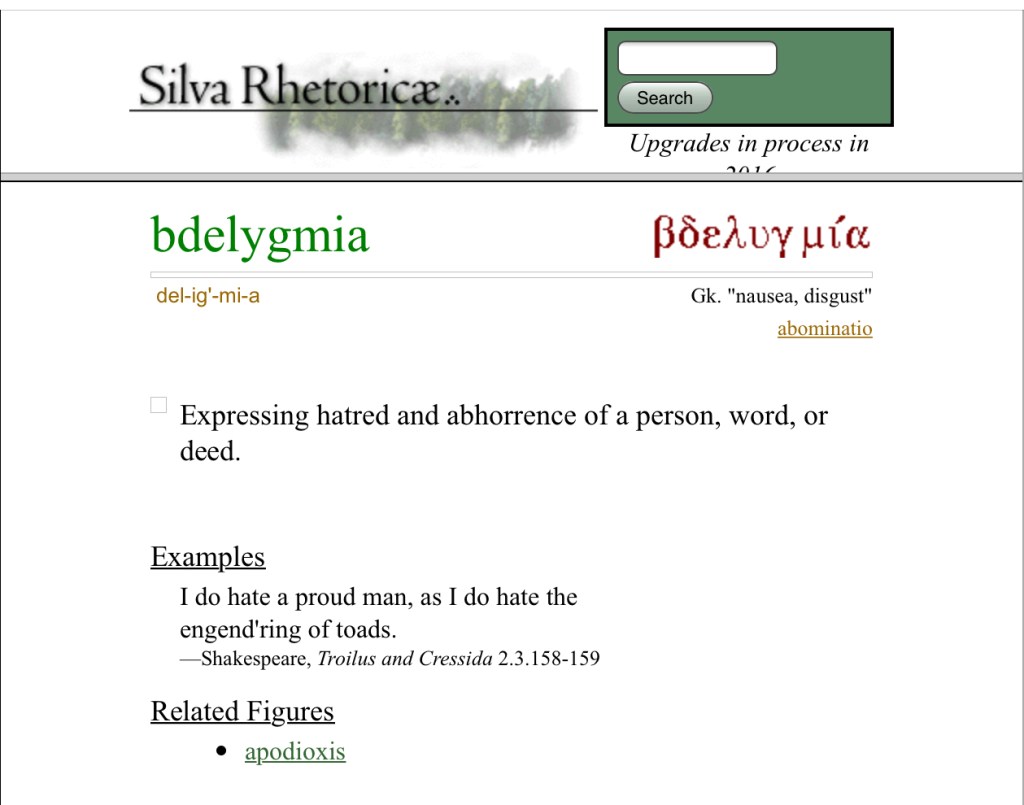
An excellent online resource for the definition and demonstration of rhetorical devices used by Shakespeare and many other dramatists, orators and writers is Silva Rhetoricæ.

The site is knowledgeable and fairly thorough, although some terms relating to Shakespeare’s plays are not included. The names of rhetorical devices are listed alphabetically, and the definitions are written in plain English with examples and alternative terms provided. There is also a handy pronunciation guide, which is really helpful when it comes to terms like ‘bdelygmia’ and ‘symploce’. 

While I do not expect my students to use the same degree of metalanguage that university students might use, there is definitely credit in nailing the key terms and using them to write about a text with greater eloquence and sophistication. 

Horror Scenes in Shakespeare: The Witches in ‘Macbeth’

While Shakespeare isn’t renowned for writing horror, he certainly understood the power of a macabre scene and the dramatic impact of horror when portraying just how evil a character could be. 
He created a number of beautifully creepy and macabre scenes that hold definite appeal for horror fans, and which make great reading for October and Halloween. 

Often referred to as the Weird Sisters, the witches of ‘Macbeth’ open the play with a powerfully macabre and horrifying scene. There is a cauldron in the middle of the cavern, around which the witches dance and recite the list of ingredients in the potion they are making. 

Just reading the recipe is enough to make one’s skin crawl – and we are nowhere near as superstitious as Shakespeare’s original audiences. 

In 1606 when the play is thought to have first been performed, audiences then would have both living memory and current knowledge of witch trials and persecutions, and would have been very wary of anything to do with witches and magic.

Shakespeare knew what we was doing, though. James I had been king of England for a few years, and  did not enjoy universal popularity among his English subjects. By portraying the witches and Macbeth as evil, he was making a powerful statement about anyone who tried to depose a Scottish king who held the throne legally and rightfully. 

So, the witches dance and sing, and Macbeth subscribes to everything they suggest about his own future, even though he first acknowledges them as “black and midnight hags”. Thus begins the dark drama of ‘Macbeth’, the Scottish play.

The Problem of Female Agency in Shakespeare’s ‘The Taming of the Shrew’
#women #Shakespeare #ShakespeareSunday

SCENE I. A cavern. In the middle, a boiling cauldron.

Thunder. Enter the three Witches

First Witch
Thrice the brinded cat hath mew’d.

Second Witch
Thrice and once the hedge-pig whined.

Third Witch
Harpier cries ‘Tis time, ’tis time.

First Witch
Round about the cauldron go;
In the poison’d entrails throw.
Toad, that under cold stone
Days and nights has thirty-one
Swelter’d venom sleeping got,
Boil thou first i’ the charmed pot.

ALL
Double, double toil and trouble;
Fire burn, and cauldron bubble.

Second Witch
Fillet of a fenny snake, I
n the cauldron boil and bake;
Eye of newt and toe of frog,
Wool of bat and tongue of dog,
Adder’s fork and blind-worm’s sting,
Lizard’s leg and owlet’s wing,
For a charm of powerful trouble,
Like a hell-broth boil and bubble.

ALL
Double, double toil and trouble;
Fire burn and cauldron bubble.

Third Witch
Scale of dragon, tooth of wolf,
Witches’ mummy, maw and gulf
Of the ravin’d salt-sea shark,
Root of hemlock digg’d i’ the dark,
Liver of blaspheming Jew,
Gall of goat, and slips of yew
Silver’d in the moon’s eclipse,
Nose of Turk and Tartar’s lips,
Finger of birth-strangled babe
Ditch-deliver’d by a drab,
Make the gruel thick and slab:
Add thereto a tiger’s chaudron,
For the ingredients of our cauldron.

ALL
Double, double toil and trouble;
Fire burn and cauldron bubble.

Second Witch
Cool it with a baboon’s blood,
Then the charm is firm and good.

Enter HECATE to the other three Witches

HECATE
O well done! I commend your pains;
And every one shall share i’ the gains;
And now about the cauldron sing,
Live elves and fairies in a ring,
Enchanting all that you put in.

Music and a song: ‘Black spirits,’ & c
HECATE retires

Second Witch
By the pricking of my thumbs,
Something wicked this way comes.
Open, locks, Whoever knocks!

Enter MACBETH

MACBETH
How now, you secret, black, and midnight hags! What is’t you do?

Read the rest of the scene, or the whole play, here.

Misunderstood Shakespeare: The Balcony Scene

Pretty much anywhere you go, whoever you talk to, if they know only one thing about any play by Shakespeare, it’s the balcony scene from Romeo and Juliet. It’s possibly the most famous scene ever written. 

There’s just one problem with that:  there was no balcony. 

That’s correct. 

There. 
Never. 
Was. 
A.
Freaking.
Balcony. 

In the script, the stage direction is clear: JULIET appears above at a window. 

Not a balcony. A window. 

You can read the entire scene and see that not once is a balcony mentioned. 

I don’t know who invented it, but it was a killer idea that I bet Shakespeare would wish he had thought of, were he still alive today. 

Of course, directors can stage a play however they like, and make use of whatever structures, sets and furniture is available to them. 

Filmmakers can do likewise, but one must keep in mind their tendency to just change whatever they want. Hollywood is notorious for that. The mayhem that comes from mass misunderstanding occurs when directors think they know better than the author, and when people watch a movie instead of reading the book.

It makes people and their assumptions about the original text wrong, and leaves them marinating in their wrongness until their wrongness is so commonly accepted that most people think it’s right. 

It just goes to show that what your English teacher always said is true: there really is no substitute for reading the book.

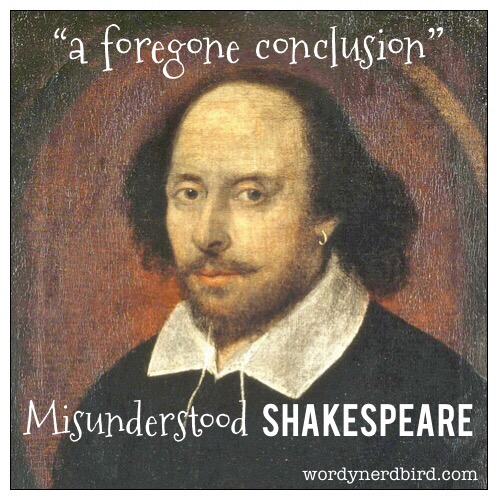
Misunderstood Shakespeare: “A Foregone Conclusion”

These days, when people talk about a “foregone conclusion” they mean something is a given: it is inevitable, it will happen, it may safely be assumed. As certain as it sounds, it is still a statement of conjecture about an event that is yet to occur.

When Shakespeare had Othello speak those words in Act 3, Scene 3 of the play that bears his name, it had quite the opposite meaning.
In this scene, Iago is manipulating Othello’s thoughts and making him believe that Desdemona has cheated on him. 

Othello says, “But this denotes a foregone conclusion:  Tis a shrewd doubt, though it be a dream.” 

Here, he is speaking of the adultery between Desdemona and Cassio as something that he is certain has already happened. This gives the phrase “foregone conclusion” the opposite meaning to that which it holds today. 

This, and statements such as “I’ll tear her all to pieces” and “O blood, blood, blood!” are evidence that Othello has already made up his mind about the guilt of his wife and former second-in-command. 

The scene ends with Othello swearing his loyalty to Iago and thinking of ways to kill Desdemona. Charming, I know. 

Misunderstood and Misquoted Shakespeare: “Lead on, Macduff!”

“Lead on, Macduff!” is a phrase often used to say “after you” when people are being polite and opening doors for someone, or showing that they will follow another person’s lead. 

People who use this phrase think they are quoting Shakespeare’s ‘Macbeth’, but they’re not quite doing so: those are not the words Shakespeare wrote. 

Both the phrase and its meaning have been changed over time. 

What Shakespeare wrote was “Lay on, Macduff”, and Macbeth wasn’t opening any doors or following Macduff’s lead when he said it. Macbeth and Macduff were fighting one another, and only one of them would survive. The words “Lay on, Macduff” were Macbeth saying “come on, fight me!”

So, next time you open a door, or commit to following someone else’s lead, be careful about saying “Lead on, Macduff”. If they know their Shakespeare, they might just fight you! 

Misunderstood Shakespeare: ‘Sea Change’

These days we understand the phrase “sea change” to reflect something new and positive in one’s life. It is frequently used to describe a significant transformation in a person or in one’s lifestyle.

In Australia, it has also come to mean a physical move from the city or the country to live closer to the ocean, or even taking a holiday at the beach. 

The phrase hasn’t always had such positive associations. 

In Act 1, Scene 2 of Shakespeare’s play ’The Tempest’, Prospero’s familiar spirit Ariel sings a song that makes Ferdinand believe that his father, Alonso, has drowned in a shipwreck, and that his father is buried at sea “full fathom five”, or five fathoms deep. Through the action of the water on his remains, his body is undergoing substantive changes: his eyes are turning into pearls and his bones into coral. There is nothing left of him that has not been transformed by the sea. 

Even worse, this story of the shipwreck and drowning is not true. It is, in fact, a ruse by Prospero to orchestrate a marriage match between his daughter, Miranda, and Ferdinand. Prospero is quite comfortable with using trickery and misleading magic to achieve what he wants to, and this is not the only time during this play that he willingly deceives others to get what he wants. 

So, even though it does still reflect a significant transformation, it has much darker connotations than the term does now. Deceit, manipulation, grief and emotional blackmail all factor into the origins of this phrase that we use so differently today. 

Misunderstood Shakespeare: “Let’s Kill All The Lawyers”

This line comes from Henry VI, Part 2, written in 1598. It was spoken by Dick the Butcher, a character nobody remembers except for this line, who was hanging about with his fellow rebels in a field at Blackheath.

It’s often quoted by people who are disillusioned with the legal system, or feel that certain members of the legal profession have less integrity than they should do. It is with these people for whom Dick the Butcher is likely to identify and sympathise. 

It is important to understand that the intent of the line was to be funny — a sardonic response from the sort of character who is likely to have suffered at the hands of a lawyer or witnessed them acting less than judiciously— rather than a serious suggestion or a statement of intent. When you read the scene as a whole, the jaded weariness of Dick and his mates is clearly evident as a contributing factor to their rebellion. This is the context in which this quotation must be read. 

Dick the Butcher is part of a group of rebels led by Jack Cade, who is extolling his qualifications to be king because of his noble connections, while the others are having a bit of a laugh at him because, realistically, he’s anything but noble. Jack does have ideas about a more egalitarian society, which form the context for Dick the Butcher’s punch line. As far as he’s concerned, if there were going to be some kind of ideal society, it wouldn’t have any lawyers in it. 

Cade concurs with Dick: lawyers using parchment to create documents is a waste of good lambs’ skins, and the beeswax used as a seal stings more than the bee does. He agreed to something legally once, and somehow gave up his freedom or rights by doing so. He doesn’t clarify what the issue was, but the audience certainly understands his sentiments regarding lawyers. 

The misunderstanding and misuse of this quotation arise from the interpretation that Shakespeare is saying that it’s the lawyers and upstanding citizens who would stand in the way of such a rebellion working because of their integrity and commitment to enforcing the law. 

I would be willing to put money on that theory having been dreamed up by a lawyer in the first place.  

If the predominant population of Shakespeare’s audiences were made up of lawyers, judges and clerks, this theory may have more credence.

However, the audiences were comprised of a much wider representation of society as a whole, only a small percentage of which was made up of lawyers. Many were quite common folk who stood throughout the performances, known as groundlings, while others were wealthier and could afford to pay for a seat. While some of those may have been lawyers, most were lords and ladies and members and other members of the gentry. 

It does seem that even in Shakespeare’s time there was a fair degree of scepticism about lawyers. While Shakespeare mentions the legal profession more than any other, this is by no means the only play in which Shakespeare makes a joke at their expense. Mercutio, for example, talks about lawyers grasping for money in ‘Romeo and Juliet’, while the Fool in ‘King Lear’ makes a pointed statement about lawyers not saying or doing anything unless you pay them first. 

Shakespeare was not trying to incite violence against lawyers, but he certainly wasn’t suggesting that they are the protectors or upholders of society, either.  Dick’s statement is clearly satire, expressing cynicism about lawyers in ways that people understood even then.