Satisfying Shakespearean Ways To Tell Someone To Go Away #3: Aroint Thee!

Photo by Andrea Plaquiqdo via Pexels.com

There are times when each of us needs to tell someone to go away. Adding a Shakespearean flavour to it lends both style and emphasis to any ejection of a bothersome person.  It can also deliver a most satisfying sense of accomplishment to lovers of Shakespeare or of language in general.

The Problem of Female Agency in Shakespeare’s ‘The Taming of the Shrew’
#women #Shakespeare #ShakespeareSunday

Aroint thee! Is stronger than Get thee gone! or Get thee hence! because of its implied disrespect for the recipient of the command.This intransitive verb of unknown origin means ‘go away’ or ‘begone’, but at the same time indicates that the speaker holds higher status or demands more respect than those to whom they are speaking.

Shakespeare uses this command twice in different plays.

In King Lear’, Act 3 Scene 4, Edgar has disguised himself as Poor Tom and feigns madness after his brother Edmund, who has allied himself with Lear’s faithless daughters Goneril and Regan and their husbands, convinced his father Gloucester that Edgar seeks to kill him. A manhunt ensues, and when Gloucester appears in this scene carrying a lit torch, Edgar speaks thus:

“This is the foul fiend Flibbertigibbet; he begins at curfew, and walks till the first cock; he gives the web and the pin, squinies the eye, and makes the hare-lip; mildews the white wheat, and hurts the poor creature of earth.
Swithold footed thrice the ’old,
He met the night-mare and her nine-fold;
Bid her alight,
And her troth plight,
And aroint thee, witch, aroint thee.

Anyone observing Edgar’s behaviour and apparently senseless ramblings would dismiss him as a madman, just as Gloucester did, but Edgar’s meaning here is clear: Gloucester is acting under the influence of evil, and Edgar is telling him to leave.

Given the widespread fear and superstition associated with witchcraft in early modern times, it would have been a natural understanding among Shakespeare’s audiences that even a madman has higher social status than a witch: he may be crazy, but at least he is not a willing agent of evil.

The Problem of Female Agency in Shakespeare’s ‘The Taming of the Shrew’
#women #Shakespeare #ShakespeareSunday

The spiritual connotation of aroint thee! is also demonstrated in Macbeth, Act 1 Scene 3, where one of the Wyrd Sisters recounts a conversation between herself and a sailor’s wife:
“A sailor’s wife had chestnuts in her lap,
And mounch’d, and mounch’d, and mounch’d. “Give me!” quoth I.
“Aroint thee, witch!” the rump-fed ronyon cries.
Her husband’s to Aleppo gone, master o’ th’ Tiger;
But in a sieve I’ll thither sail,
And like a rat without a tail,I’ll do,
I’ll do, and I’ll do.”

That the sailor’s wife bids the witch leave with the command “Aroint thee, witch!” underscores the difference in social and spiritual status between the two.

The Problem of Female Agency in Shakespeare’s ‘The Taming of the Shrew’
#women #Shakespeare #ShakespeareSunday

At those times when ‘get thee gone’ and ‘get thee hence’ don’t seem to pack enough punch, ‘aroint thee’ might be just the phrase you need to achieve your goal in a most satisfyingly Shakespearean manner.

Aroint Thee!
#Shakespeare #language #words

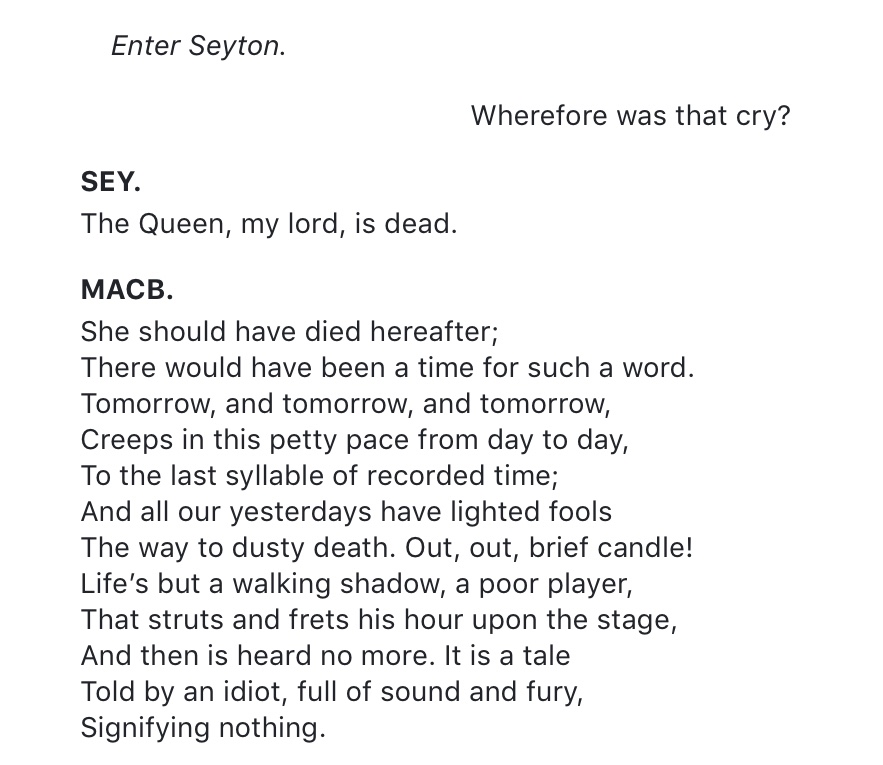
Life’s But A Walking Shadow

Macbeth, V.v

This short speech by Macbeth is his response to the news that Lady Macbeth is dead. It is not as emotional as Macduff’s response to the death of his wife and children, but instead is quite poignant and philosophical. A soliloquy might have been more expansive on his thoughts and feelings.

It is a reflection on the brevity and meaninglessness of life. Every day we live is someone else’s last, and our stories are full of noise and bother, but ultimately pointless. 

Perhaps he anticipated her death, given her descent into guilty madness. His observation that “She should have died hereafter; There would have been time for such a word” suggests that he thought he had bigger problems at that point, and he simply didn’t have time to grieve properly. Implying that her timing was inconvenient is the kind of self-interest that those who love to hate Macbeth might find satisfying. 

Either way, Macbeth’s musings on the futility of life contrast profoundly with his belief in his own invincibility and his headstrong determination to fight to keep the kingdom he usurped by killing Duncan and blaming it on his bodyguards. 

It just goes to show that you can not encapsulate a character in one quotation or by examining one event. Shakespeare’s leading characters are complex, conflicted individuals designed to provoke thought and conscience. Macbeth is no exception. 

Horror Scenes in Shakespeare: “Out, damned spot!” The Blood on Lady Macbeth’s Hands

While Shakespeare isn’t renowned for writing horror, he certainly understood the power of a macabre scene and the dramatic impact of horror when portraying just how evil a character could be. 
He created a number of beautifully creepy and macabre scenes that hold definite appeal for horror fans, and which make great reading for October and Halloween. 

The Problem of Female Agency in Shakespeare’s ‘The Taming of the Shrew’
#women #Shakespeare #ShakespeareSunday

The horror of Act 5, Scene 1 of Macbeth is subtle, but very real. While there is no real blood on the stage, there is definitely blood on Lady Macbeth’s hands. 

After belittling Macbeth more than once for being haunted by visions and ghosts, the same thing happens to Lady Macbeth – or Lady Macdeath, as I like to call her. She is spared such public humiliation, though – her suffering is is revealed in the privacy of her own rooms, witnessed only by her servant and a doctor. This enables the audience to witness the intensely personal and intimate nature of the psychological horror experienced by Lady Macbeth.

In the chaos of her behaviour, the audience sees the extent of Lady Macbeth’s mental torment: she is plagued by guilt and losing her grip on reality. She walks and talks in her sleep, carrying a candle because she cannot bear to be in darkness, and speaking of fragments of bloody images and events. She repeatedly acts as though she is washing her hands, sometimes for fifteen minutes, yet she can never seem to get them clean. She keeps on finding blood on her hands: “Yet here’s a spot.”

Despair and frustration underscore pronouncements such as “Out, damned spot! Out, I say!” and “What! will these hands ne’er be clean?

In her mind, she can still clearly smell and see the blood on her own hands after the murder of Duncan, observing “Here’s the smell of the blood still: all the perfumes of Arabia will not sweeten this little hand. Oh! oh! oh!”. 

The doctor and gentlewoman who look on within the scene are disturbed by what they see before them, positioning the audience to share in their disquiet. Her macabre imagery and references to blood and ghosts cause the doctor to conclude that  “Unnatural deeds 
Do breed unnatural troubles; infected minds
To their deaf pillows will discharge their secrets;
More needs she the divine than the physician.” 


The doctor speaks what the audience already knows: it is Lady Macbeth’s conscience rather than her hands that cannot be cleansed. When he instructs the gentlewoman to watch her carefully and remove anything that she might use to harm herself, he is alluding to things that Shakespeare’s generally superstitious audiences would have interpreted as horrific in itself – spiritual torment as a result of one’s own sins, and the thought of committing suicide in such a state, were appalling and dreadful to those who had been taught of the eternal damnation of one who took their own life or died otherwise completely unreconciled with God. The good folk of early modern England feared many things, but burial in unconsecrated ground and spending eternity in hell were right at the top of most people’s list of things they wanted to avoid. Had it been otherwise, the early modern church would have been far less powerful and prominent in the lives of the English people. 

Throughout this scene, the power of a guilty conscience over one’s psyche is vividly expressed using the depiction and the imagery of horror. 

Shakespeare also uses the Macbeths’ experiences as a distinct reminder of the fact that regicide is never a good idea because the consequences are enormous for the nation as a whole, but it also has significant and permanent spiritual consequences for the perpetrators. Given the number of plots against James I, a Scottish king long before he became an English one, this was a politically expedient message for Shakespeare to deliver to his audiences while at the same time telling a deliciously dark and macabre story. 

The Problem of Female Agency in Shakespeare’s ‘The Taming of the Shrew’
#women #Shakespeare #ShakespeareSunday

You can read the whole scene, or the entire play, here

Horror Scenes In Shakespeare: Banquo’s Ghost in ‘Macbeth’

While Shakespeare isn’t renowned for writing horror, he certainly understood the power of a macabre scene and the dramatic impact of horror when portraying just how evil a character could be. 
He created a number of beautifully creepy and macabre scenes that hold definite appeal for horror fans, and which make great reading for October and Halloween. 

The Problem of Female Agency in Shakespeare’s ‘The Taming of the Shrew’
#women #Shakespeare #ShakespeareSunday

There is a beautifully crafted moment in Act 3, Scene 4 of ‘Macbeth’ where Macbeth, Lady Macbeth, and a group of lords gather for dinner. There is no place set for Banquo, because Macbeth knows he will not attend dinner – he cannot, because Macbeth has had him murdered. 

Just as Macbeth is about to sit down, he makes a speech saying that all the greatest men of the kingdom would be under one roof if Banquo were there, but he hasn’t deigned to join them. At that moment, Banquo’s ghost has shown up and taken Macbeth’s seat. Macbeth, not realising the others can’t see Banquo, tells Ross he can’t sit down because the table’s full. Lennox shows him to his place, and Macbeth starts acting very strangely. He directly addresses Banquo’s ghost, saying “Thou canst not say I did it: never shake thy gory locks at me.” 

This is a most macabre picture indeed. Banquo’s ghost isn’t all white and ethereal, it’s covered in blood and grey matter after having his head bashed in, to the point where his hair is dripping with it. 

To the others at the table, the agitated and protesting Macbeth appears to be talking to no-one.  

Ross assumes Macbeth is not feeling well. Lady Macbeth, as gracious and supportive of her husband as ever, tells them he’s having a brain snap, it happens all the time, and it will be over in no time if they ignore him. When she questions his masculinity, he says he is indeed a man – a bold enough one to look on something so scary that it would give the devil a fright. Then she tells him he’s imagining things again, and carrying on as though he were listening to an old woman’s fireside horror story. 

He continues pointing it out – “Prithee, see there! behold! look! lo!” and tells the ghost that if it can nod, it should speak to him too. Macbeth knows exactly what – or who – he is seeing, and it terrifies him. 

The scene is quite bizarre. The man who is ostensibly the king of Scotland starts talking to nobody and his wife undermines both his sanity and his manhood in front of all his lords. The dramatic irony of the audience knowing Banquo’s ghost has appeared, while the other attendees at the dinner do not, is compelling, giving the audience a powerful sense of horror — both at the scene as they witness it, and at the thought of what is to become of the kingdom. It contributes to the building sense of impending doom and adds another layer of darkness to this most bloody tragedy. 

The Problem of Female Agency in Shakespeare’s ‘The Taming of the Shrew’
#women #Shakespeare #ShakespeareSunday

Read the rest of the scene – or the whole play – here

Check out Mya Gosling’s brilliant cartoon version of this scene at Good Tickle Brain.

Horror Scenes in Shakespeare: The Witches in ‘Macbeth’

While Shakespeare isn’t renowned for writing horror, he certainly understood the power of a macabre scene and the dramatic impact of horror when portraying just how evil a character could be. 
He created a number of beautifully creepy and macabre scenes that hold definite appeal for horror fans, and which make great reading for October and Halloween. 

Often referred to as the Weird Sisters, the witches of ‘Macbeth’ open the play with a powerfully macabre and horrifying scene. There is a cauldron in the middle of the cavern, around which the witches dance and recite the list of ingredients in the potion they are making. 

Just reading the recipe is enough to make one’s skin crawl – and we are nowhere near as superstitious as Shakespeare’s original audiences. 

In 1606 when the play is thought to have first been performed, audiences then would have both living memory and current knowledge of witch trials and persecutions, and would have been very wary of anything to do with witches and magic.

Shakespeare knew what we was doing, though. James I had been king of England for a few years, and  did not enjoy universal popularity among his English subjects. By portraying the witches and Macbeth as evil, he was making a powerful statement about anyone who tried to depose a Scottish king who held the throne legally and rightfully. 

So, the witches dance and sing, and Macbeth subscribes to everything they suggest about his own future, even though he first acknowledges them as “black and midnight hags”. Thus begins the dark drama of ‘Macbeth’, the Scottish play.

The Problem of Female Agency in Shakespeare’s ‘The Taming of the Shrew’
#women #Shakespeare #ShakespeareSunday

SCENE I. A cavern. In the middle, a boiling cauldron.

Thunder. Enter the three Witches

First Witch
Thrice the brinded cat hath mew’d.

Second Witch
Thrice and once the hedge-pig whined.

Third Witch
Harpier cries ‘Tis time, ’tis time.

First Witch
Round about the cauldron go;
In the poison’d entrails throw.
Toad, that under cold stone
Days and nights has thirty-one
Swelter’d venom sleeping got,
Boil thou first i’ the charmed pot.

ALL
Double, double toil and trouble;
Fire burn, and cauldron bubble.

Second Witch
Fillet of a fenny snake, I
n the cauldron boil and bake;
Eye of newt and toe of frog,
Wool of bat and tongue of dog,
Adder’s fork and blind-worm’s sting,
Lizard’s leg and owlet’s wing,
For a charm of powerful trouble,
Like a hell-broth boil and bubble.

ALL
Double, double toil and trouble;
Fire burn and cauldron bubble.

Third Witch
Scale of dragon, tooth of wolf,
Witches’ mummy, maw and gulf
Of the ravin’d salt-sea shark,
Root of hemlock digg’d i’ the dark,
Liver of blaspheming Jew,
Gall of goat, and slips of yew
Silver’d in the moon’s eclipse,
Nose of Turk and Tartar’s lips,
Finger of birth-strangled babe
Ditch-deliver’d by a drab,
Make the gruel thick and slab:
Add thereto a tiger’s chaudron,
For the ingredients of our cauldron.

ALL
Double, double toil and trouble;
Fire burn and cauldron bubble.

Second Witch
Cool it with a baboon’s blood,
Then the charm is firm and good.

Enter HECATE to the other three Witches

HECATE
O well done! I commend your pains;
And every one shall share i’ the gains;
And now about the cauldron sing,
Live elves and fairies in a ring,
Enchanting all that you put in.

Music and a song: ‘Black spirits,’ & c
HECATE retires

Second Witch
By the pricking of my thumbs,
Something wicked this way comes.
Open, locks, Whoever knocks!

Enter MACBETH

MACBETH
How now, you secret, black, and midnight hags! What is’t you do?

Read the rest of the scene, or the whole play, here.

Misunderstood and Misquoted Shakespeare: “Lead on, Macduff!”

“Lead on, Macduff!” is a phrase often used to say “after you” when people are being polite and opening doors for someone, or showing that they will follow another person’s lead. 

People who use this phrase think they are quoting Shakespeare’s ‘Macbeth’, but they’re not quite doing so: those are not the words Shakespeare wrote. 

Both the phrase and its meaning have been changed over time. 

What Shakespeare wrote was “Lay on, Macduff”, and Macbeth wasn’t opening any doors or following Macduff’s lead when he said it. Macbeth and Macduff were fighting one another, and only one of them would survive. The words “Lay on, Macduff” were Macbeth saying “come on, fight me!”

So, next time you open a door, or commit to following someone else’s lead, be careful about saying “Lead on, Macduff”. If they know their Shakespeare, they might just fight you! 

Misunderstood and Misquoted Shakespeare: “One Foul Swoop”

This morning’s conversation in my kitchen is a clear demonstration of just how much of a Shakespeare Nerd I really am.

H: I need egg cartons. Where do I get egg cartons? 
Me: How many do you want? 
I pointed to the top of my fridge where there sat a stack of egg cartons. 
Me again: Take them all. 
H: Oh wow! Thanks! 
K: That’s awesome! I’ll grab them in one foul swoop and put them in the car.
Me: Well, that’s decided my blog post for today. 
K: Huh? 

In Act 4, Scene 3 of ‘Macbeth’, Malcolm and Macduff engage in testing one another’s loyalty to Scotland rather than to Macbeth, who has become king. During that conversation, Macduff learns of the murders of his wife and children at the order of Macbeth, whom he describes as a “hell-kite” who has slain his “chickens” in “one fell swoop”. 


The deed was certainly foul, but that isn’t what Shakespeare wrote. He wrote “one fell swoop” which is an entirely different thing. 

Here, fell means ‘fierce’. 

It’s an image of violent attack, of hunting, and of predator and prey, which leaves the audience in no doubt that these murders were calculated and precise. The term “hell-kite” leaves the audience in no doubt of the evil motivations behind the slaying.

An Interesting Character Study: Macbeth

Macbeth is certainly one of Shakespeare’s very interesting characters. 

Macbeth and his wife present an interesting study of power, control and submission. A proven warrior, he lets not only his imagination, but also his wife’s, run away with him, and completely submits to her manipulation and taunting. Instead of waiting for things to take their natural course, they took matters into their own hands in pursuit of the position and power promised in the prophecy of the wyrd sisters. 

As things are wont to do in Shakespeare’s tragedies, things get way out of hand and end up with a bunch of people dead. 

I hope you enjoy this very good character study of Macbeth, courtesy of the Interesting Literature blog. 

An Interesting Character Study: Macbeth

Macbeth is one of Shakespeare’s most famous tragic heroes, not least because he represents the Man Who Has It All (seemingly) and yet throws it away because of his ‘vaulting ambition’ to have Even …

Source: An Interesting Character Study: Macbeth

A Favourite Shakespeare Play: ‘Macbeth’

Macbeth is a play that has always fascinated people, engaging their superstitions as well as their imaginations. For this reason, its often called The Scottish Play by actors and theatre folk, as it’s believed to be unlucky to say ‘Macbeth’ in a theatre.

It’s a cracker of a story. The supernatural ‘weird sisters’ tell Macbeth he’s going to be Thane of Cawdor, and then tell him he is going to be king. In response, Macbeth does everything in his power to make it happen, only to be haunted by his victims and unable to actually enjoy his success when it does. You really do have to wonder how it would have all worked out if he’d responded with, “That’s nice!” and let things happen as they would. 

Of course, you can’t just blame it all on Macbeth. His wife – whom I like to call Lady Macdeath – plays a significant part in engineering him onto the throne, mostly by bullying him into doing things he doesn’t really want to do.

The play has some fabulous macabre moments— the witches are spooky, their prophecies are uncanny, and you can bet your last dollar you don’t want to eat what they’re cooking in that cauldron. Even better is the part where Banquo’s ghost shows up for dinner shaking his “gory locks”: that is my favourite scene in the whole play.

Laced with suspense, intrigue, and dramatic irony, ‘Macbeth’ keeps the audience hooked to the very end, even though we all know by now how it’s going to work out. There’s more magic than just “Double, double, toil and trouble / Fire burn and cauldron bubble” in this play. 

Strangely enough, reading the text has brought me some odd comfort this weekend as I contemplate the fate of people who manipulate, lie and use others for their own nefarious purposes. I have taken dark satisfaction in seeing those who chose to do evil get what they deserved in the end. It may not be gracious, but it is quite therapeutic to think that maybe the Fates really do have things under control. Sometimes you need to take your catharsis wherever you can get it. 

That, of course, is the genius of all Shakespeare’s plays. He deals in the emotions we all understand – ambition, greed, love, anger, jealousy, pride, and the experience of being at the receiving end of the bad behaviour of others. The language may have changed slightly, but human nature certainly has not. 

Shakespeare doesn’t have to work hard to make the audience dislike Macbeth and his cold-hearted shrew of a wife: we get it. We have all seen people succeed by means of deceiving and manipulating others, or by stabbing someone else in the back, and we don’t like them, either.