Shakespeare’s Baubles.


Because it’s December and Christmas decorations are everywhere, I wrote last night about the meanings and etymology of the word ‘bauble’ on WordyNerdBird. I wondered then if it were a word used by Shakespeare. To my delight, it was indeed!

Interestingly, Shakespeare references one of the continued senses and the obsolete sense of the word, and creates double entendre with it for extra credit.

In ‘Cymbeline’, the queen refers to Caesar’s ships bobbing around on the sea as ‘ignorant baubles’, describing them further as being like egg shells, being thrown and broken against the rocks.

A similar reference to boats as ‘baubles’ is made in ‘Troilus and Cressida.

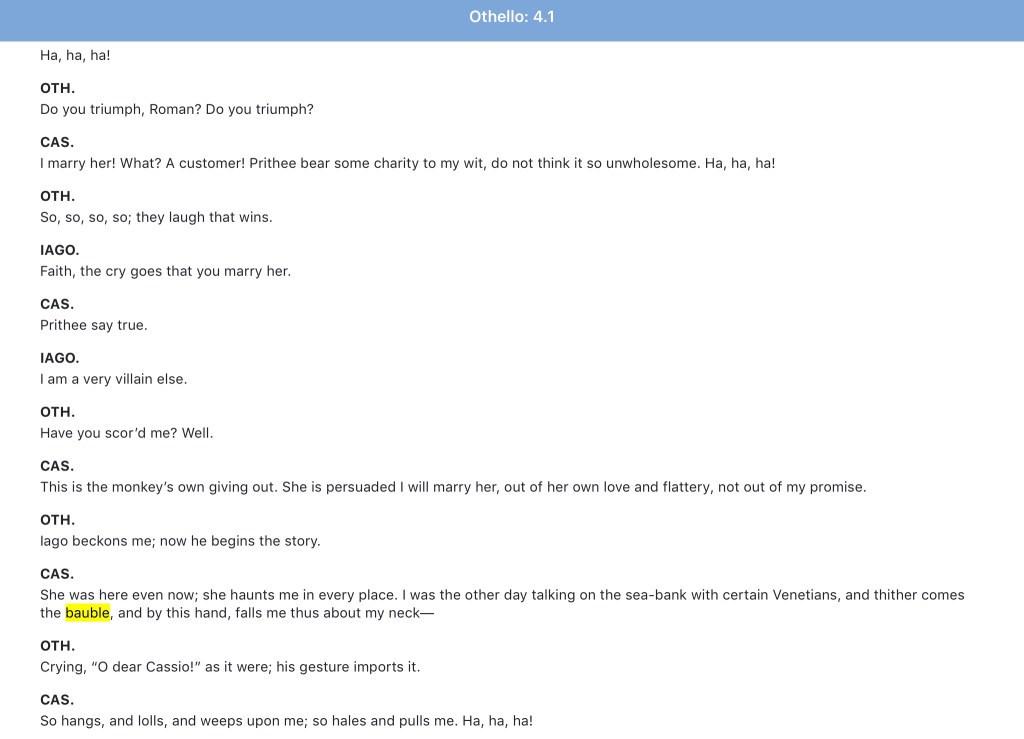
In ‘Othello’, Cassio shows his disregard for Bianca by describing her as a bauble that follows him around and tries to make him fall in love with her.  That his companions laugh with him demonstrates that this use of the word to describe a pretty but not-so-valuable woman was easily understood at the time.
In ‘The Taming of the Shrew’, ‘bauble’ is used to refer to Kate’s hat – a decorative item of clothing, which is of little value in the play other than its use as a prop in her surprising demonstration of obedience to her husband, Petruchio.

‘Timon of Athens’ references a bauble as the staff of a jester or idiot, although in this instance, Aaron the Moor is suggesting that a king holding his sceptre and claiming to be faithful to God is the equivalent of his fool holding a bauble and pretending to be the king.

This sense of ‘bauble’ is extended in All’s Well That Ends Well, where the Clown refers to cheating on a man with his wife and giving her his bauble “to do her service”.  Clearly, this is a pun on the jester’s staff, used to reference an altogether different kind of rod with a special ending on it.

This is Shakespeare’s trademark wit in action, taking common language and creating word play loaded with double entendre that would delight the masses and the ‘gentlemen’ alike.

“Thou art too malapert…”

Peacock malapert know-it-all overconfident showy
Image from PublicDomainPictures on Pixabay

Malapert refers to a person who acts like they know everything and is confident that they are always right. 

While there are a number of characters in Shakespeare’s works whom we might consider to be malapert, Shakespeare uses the word only three times in his plays.

In Henry 6, Queen Margaret and her son, the young Lancaster Prince Edward, engage in a contest of insults with their captors: Clarence and Gloucester. As sons of Richard, Duke of York these two are the Lancastrian King Henry’s enemies, as the two houses are rivals for the English throne. Clarence calls the young prince malapert, highlighting his youthful confidence by calling him an “untutor’d lad”. 

Almost as proof of Clarence’s assessment, the prince responds by insulting them again. Despite the clevernesand bravery of his words, this proved to be a bad move, as “perjur’d George” and “misshapen Dick” respond by stabbing him to death. End of argument. 

In Richard III, the same Queen Margaret tells the Marquess of Dorset that he is malapert and warns him that his newly found nobility won’t protect him from being destroyed by the Yorks, particularly Richard (Gloucester) whom  she describes as a “bottled spider” and a “poisonous bunch-back’d toad”. Richard turns the insult back on Margaret, and Dorset promptly turns it right back on him. 

In the comedy Twelfth Night, Sir Toby Belch and Sebastian are engaged in an argument when Sir Toby insists that he “must have an ounce or two of this malapert blood” from his rival. 

Malapert
#words #Shakespeare #ShakespeareSunday

Knowing Your Literary Devices.

Knowing the literary devices used by Shakespeare and how they work helps those who read or study his works understand the ways in which he has shaped and crafted meaning in the lines delivered by his characters and in his poetry. It also helps readers to recognise the difference between literal and figurative language, and therefore to interpret more correctly the message of particular lines and scenes, and of texts as a whole. 

Of course, there are the standard ones that everyone should learn in school: simile, metaphor, alliteration, repetition hyperbole.  In senior high, that should extend to more sophisticated devices specific to the text being studied. My senior English class is studying ‘RichardIII’, so they are learning about stichomythia, anaphora and antithesis among others. Irony and dramatic irony are also heavy hitters in this play, so while they are by no means new concepts to the students, we are discussing them in detail. 

An excellent online resource for the definition and demonstration of rhetorical devices used by Shakespeare and many other dramatists, orators and writers is Silva Rhetoricæ.

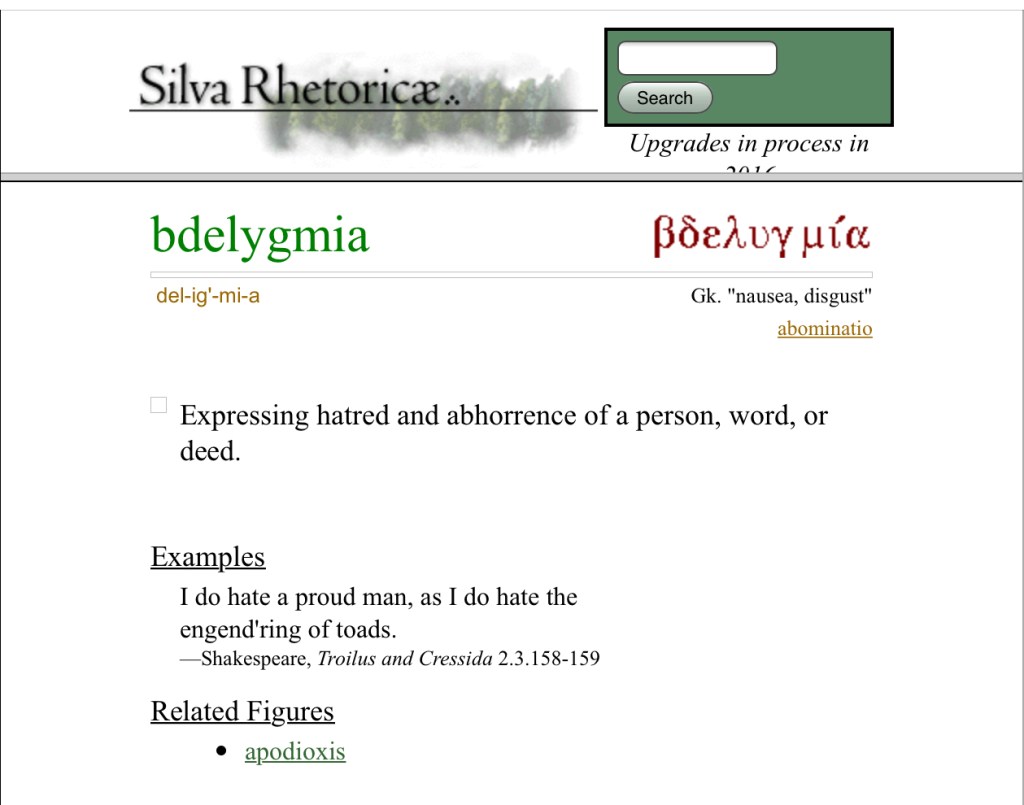
The site is knowledgeable and fairly thorough, although some terms relating to Shakespeare’s plays are not included. The names of rhetorical devices are listed alphabetically, and the definitions are written in plain English with examples and alternative terms provided. There is also a handy pronunciation guide, which is really helpful when it comes to terms like ‘bdelygmia’ and ‘symploce’. 

While I do not expect my students to use the same degree of metalanguage that university students might use, there is definitely credit in nailing the key terms and using them to write about a text with greater eloquence and sophistication. 

Misunderstood Shakespeare: ‘Sea Change’

These days we understand the phrase “sea change” to reflect something new and positive in one’s life. It is frequently used to describe a significant transformation in a person or in one’s lifestyle.

In Australia, it has also come to mean a physical move from the city or the country to live closer to the ocean, or even taking a holiday at the beach. 

The phrase hasn’t always had such positive associations. 

In Act 1, Scene 2 of Shakespeare’s play ’The Tempest’, Prospero’s familiar spirit Ariel sings a song that makes Ferdinand believe that his father, Alonso, has drowned in a shipwreck, and that his father is buried at sea “full fathom five”, or five fathoms deep. Through the action of the water on his remains, his body is undergoing substantive changes: his eyes are turning into pearls and his bones into coral. There is nothing left of him that has not been transformed by the sea. 

Even worse, this story of the shipwreck and drowning is not true. It is, in fact, a ruse by Prospero to orchestrate a marriage match between his daughter, Miranda, and Ferdinand. Prospero is quite comfortable with using trickery and misleading magic to achieve what he wants to, and this is not the only time during this play that he willingly deceives others to get what he wants. 

So, even though it does still reflect a significant transformation, it has much darker connotations than the term does now. Deceit, manipulation, grief and emotional blackmail all factor into the origins of this phrase that we use so differently today. 

Misunderstood Shakespeare: “What The Dickens”

Many people assume that “What the dickens?” is a reference to the author Charles Dickens. 

Considering that Shakespeare wrote this expression in ‘The Merry Wives of Windsor’ in 1600 and Charles Dickens was born in 1812, that is entirely impossible. 

Instead, ‘dickens’ is a euphemism for ‘devil’, as is ‘deuce’. When Mrs Page says “I cannot tell what the dickens his name is…” she really means ‘what the devil”.

It’s a more polite way of expressing strength of an idea or emphasising their intent, in this case, that she has no idea of the identity of the person she is being asked about. It’s exactly the same as people saying ‘heck’ instead of hell, ‘gosh’ instead of ‘God’ and ‘jeez’ instead of ‘Jesus’, and is probably  done for the same reason: superstitious avoidance of using religious terms, or “using in vain” the names of religious entities. 

There’s also a chance that, for some folks, old-fashioned good manners may enter into it, too. 

In short, this is a euphemism: an inoffensive word or phrase used to replace an impolite or offensive one. We use euphemism when we talk about “powdering my nose” or “going to see a man about a dog” instead of “going to the bathroom”, or “bathroom” instead of “toilet”.

Like many of Shakespeare’s words and phrases, “what the dickens” has stood the test of time and is still used as a euphemism today.

Misunderstood Shakespeare: “The World’s Mine Oyster”

When people say this, they usually assume it means that the world is at their feet and they are in a position where everything is going to work in their favour. Others say it to imply that they are “the pearl” and they are being cultivated for greatness. 

However, when these lines were spoken in Shakespeare’s ’The Merry Wives of Windsor’, the intention is actually quite different. 

In a conversation between two less-than-reputable characters, this conversation takes place: 

In other words, if Falstaff won’t give him money, Pistol will go and take it forcibly from other people. It’s about taking what one is not entitled to, and it has quite violent connotations. 

An oyster does not willingly open – it has to be forced.
An oyster does not willingly give up its pearl, which can take years to develop, and the oyster is often damaged or killed in the process of extracting the pearl. 

This is an image of violence, and not one of happy or fortunate circumstances at all. 

Misunderstood Shakespeare: “Star-cross’d Lovers”

Just like ‘Wherefore art thou Romeo?”, this commonly misunderstood famous line comes ‘Romeo and Juliet’

I have witnessed so many people talking about Romeo and Juliet as “star-cross’d lovers” in the sense of their meeting and relationship being their destiny, and that the two were somehow fated to be together. 

This couldn’t be more wrong. 

The actual meaning of the term becomes clearer if one thinks of it in terms of the stars actually crossing them. 

Romeo and Juliet were never meant to be together. The fates were against them, right from the start, and it was never going to work out well. 

It’s important to remember that ‘Romeo and Juliet’ is a tragedy, not a comedy or romance. In Shakespeare’s tragedies, the main characters always die. There are no happy endings. That’s a convention of the genre, and it is pointless to expect anything else. 

Not only that, but Shakespeare gives us the spoilers right there in the prologue, the opening speech of the play, which is where the phrase comes from. They’re going to die, and as they are laid to rest, so too will be buried the feud between their families, which is what made their love forbidden in the first place. 

The prologue to Romeo and Juliet by William Shakespeare.

If, as some believe they do, the stars were to control one’s fortunes in life, the last thing you’d wish for is to be “star-crossed” in any way. 

Misunderstood Shakespeare: “Wherefore art thou Romeo?”

Of all the lines written by Shakespeare, this is possibly the single most misunderstood by a 21st century audience.

While it might be a romantic notion for a lovesick teenager to look out her window— not a balcony, by the way— and wonder where her beloved might be, that’s all it is. That is not what is happening in this scene. 

In early modern English, “wherefore” meant “why”.

Juliet is not asking where Romeo is.  She is asking why, of all the families in Italy, did her new boyfriend have to belong to the family with which hers had been feuding? Why did he have to carry a name that would be an immovable obstacle to them both? 

She goes on to insist “that which we call a rose by any other name would be as sweet”— in other words, it’s not the name that makes someone what they are.  If Romeo were to change his identity, he would still be the same person. What his name is should not matter — what sort of person he is, and the fact that she loves him, is what should determine their compatibility. 

That’s why when you’re waiting for a friend or looking for your dog, it’s incorrect to ask “Wherefore art thou, Buddy?”
It may sound cute, but it will make your Shakespeare-loving friends cringe, at least on the inside. 

On Verbing

Most of the time, when people protest about the way the English language is abused, it’s a case of the language continuing to evolve as it has always done.

One such example is the practice of verbing, which takes the noun form of a word and transforms it into a verb form… like ‘verb’ and ‘verbing’. 

Just last week, I was talking with a friend about how annoying she finds it when people say “I’m going to action that.” I’m sure she sought me out for the conversation because I’m both a word nerd and an English teacher. 

“Action is a noun! A bloody noun! How can so many otherwise intelligent people get that wrong?”

“It grates on us because it’s recent,” I said. “We’ll get used to it.”

“No, I won’t! It’s just wrong!”

“You know Shakespeare did it?”

“What?” 

“Verbing. He did it all the time.”

“You and your Shakespeare. It’s like he’s the answer to everything.” 

“You know he invented the word ‘friending’, right?”

She rolled her eyes and walked away. She didn’t even flinch at my use of the term “verbing”, which is exactly the same thing as “actioning” in terms of the language. After all, ‘verb’ is a noun, too. 

It is the recent examples of verbing, such as “actioning” an idea, that we notice because we’re not used to hearing them yet. When Facebook was new, people complained the same way about “friending”, but these days nobody thinks twice about that. At some point in time, someone decided that it was okay to talk about bottling  fruit, or shelving books, and now those terms are just everyday language. 

It is also true, however, that some things people commonly say are, quite simply, wrong

My pet peeve is when my students are talking about sport or some other kind of competition, and they say “We versed Team X”. 

This is a common bastardisation of the Latin versus, which means ‘against’. It is commonly used for sporting matches and legal cases, and is generally abbreviated as v. or vs., as in Black v. White or Blue vs. Red. 

My first response is always to ask whey they wrote poetry about another team. “You played them. You opposed them. You clashed with them. You competed with them. You did not write poetry about them.” Then I explain how the different words work, and what they actually mean. 

The reason “versed” is wrong is because the words ‘versus’ and ‘verse’ have absolutely nothing to do with each other. Because ‘against’ is a preposition, it simply doesn’t make sense to say “We againsted them”. It is not verbing, by any stretch of the imagination. 

The first time we have that conversation, they look at me with confusion. Some have a glazed look of fear, like the proverbial deer caught in the headlights. This never fails to entertain me. The second and third times, they roll their eyes.

Over time, the tedium of having the same grammar-nerdy conversation persuades them to start using the language correctly. They learn, I win, and so does the English language.