
This Valentine’s Day edition of Shakespeare Nerd is brought to you by the brilliant Mya Gosling, creator of Good Tickle Brain.


Shakespeare Nerd Valentine’s Day Edition via @goodticklebrain
Tweet
#ShakespeareSunday #ValentinesDay
This Valentine’s Day edition of Shakespeare Nerd is brought to you by the brilliant Mya Gosling, creator of Good Tickle Brain.
Shakespeare Nerd Valentine’s Day Edition via @goodticklebrain
Tweet
#ShakespeareSunday #ValentinesDay
Because it’s December and Christmas decorations are everywhere, I wrote last night about the meanings and etymology of the word ‘bauble’ on WordyNerdBird. I wondered then if it were a word used by Shakespeare. To my delight, it was indeed!


Interestingly, Shakespeare references one of the continued senses and the obsolete sense of the word, and creates double entendre with it for extra credit.

In ‘Cymbeline’, the queen refers to Caesar’s ships bobbing around on the sea as ‘ignorant baubles’, describing them further as being like egg shells, being thrown and broken against the rocks.

A similar reference to boats as ‘baubles’ is made in ‘Troilus and Cressida.
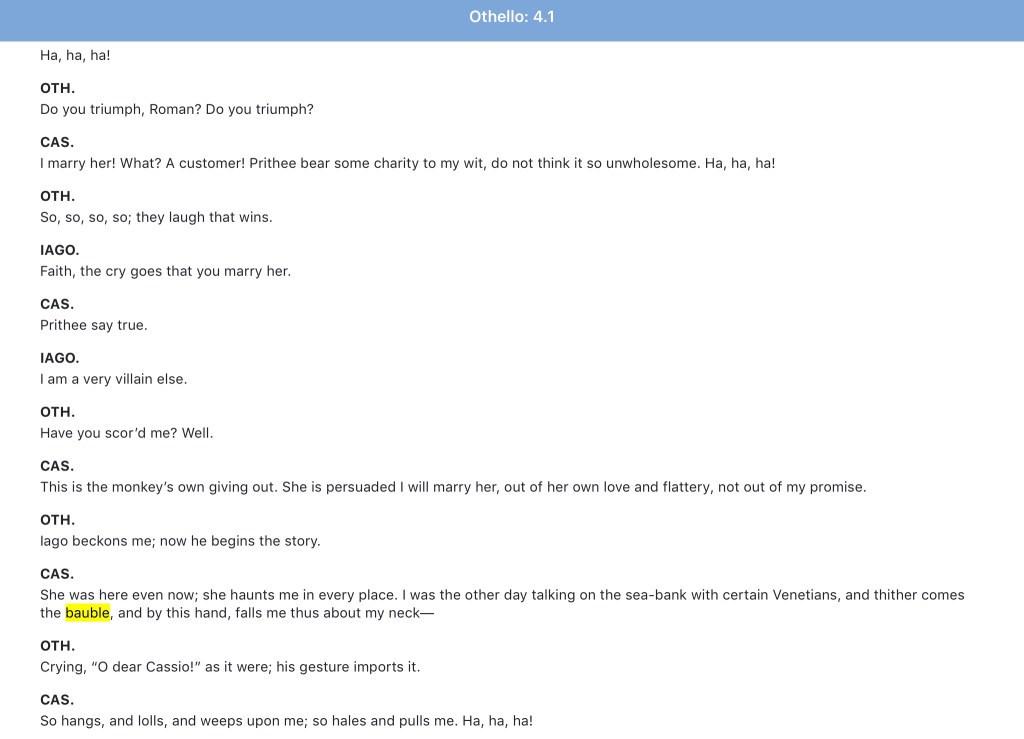
In ‘Othello’, Cassio shows his disregard for Bianca by describing her as a bauble that follows him around and tries to make him fall in love with her. That his companions laugh with him demonstrates that this use of the word to describe a pretty but not-so-valuable woman was easily understood at the time.
In ‘The Taming of the Shrew’, ‘bauble’ is used to refer to Kate’s hat – a decorative item of clothing, which is of little value in the play other than its use as a prop in her surprising demonstration of obedience to her husband, Petruchio.

‘Timon of Athens’ references a bauble as the staff of a jester or idiot, although in this instance, Aaron the Moor is suggesting that a king holding his sceptre and claiming to be faithful to God is the equivalent of his fool holding a bauble and pretending to be the king.

This sense of ‘bauble’ is extended in All’s Well That Ends Well, where the Clown refers to cheating on a man with his wife and giving her his bauble “to do her service”. Clearly, this is a pun on the jester’s staff, used to reference an altogether different kind of rod with a special ending on it.

This is Shakespeare’s trademark wit in action, taking common language and creating word play loaded with double entendre that would delight the masses and the ‘gentlemen’ alike.
Last year, I wrote a number of posts about the best Shakespeare scenes for Halloween.
This year, Mya Gosling has very kindly given permission for me to share her Shakespeare Halloween Party cartoons.
Mya is the creative genius behind Good Tickle Brain, where she turns Shakespeare’s characters and plays into insightful and amusing cartoons. I hope you enjoy her work as much as I do.


The Problem of Female Agency in Shakespeare’s ‘The Taming of the Shrew’
Tweet
#women #Shakespeare #ShakespeareSunday
Shakespeare Halloween Party
Tweet
#cartoons #Shakespeare #halloweencostume
This wonderful cartoon about social distancing and self isolation comes from the very talented hand of Mya Gosling, author of Good Tickle Brain.

If you don’t already follow Mya on Twitter or Facebook or visit her website regularly, you’re missing out.
Stay Home and Shakespeare!
Tweet
#Shakespeare #StayHomeStaySafe #StayingHomeSavesLives #ShakespeareNerd #blog

Most of the time, when people protest about the way the English language is abused, it’s a case of the language continuing to evolve as it has always done.
One such example is the practice of verbing, which takes the noun form of a word and transforms it into a verb form… like ‘verb’ and ‘verbing’.
Just last week, I was talking with a friend about how annoying she finds it when people say “I’m going to action that.” I’m sure she sought me out for the conversation because I’m both a word nerd and an English teacher.
“Action is a noun! A bloody noun! How can so many otherwise intelligent people get that wrong?”
“It grates on us because it’s recent,” I said. “We’ll get used to it.”
“No, I won’t! It’s just wrong!”
“You know Shakespeare did it?”
“What?”
“Verbing. He did it all the time.”
“You and your Shakespeare. It’s like he’s the answer to everything.”
“You know he invented the word ‘friending’, right?”
She rolled her eyes and walked away. She didn’t even flinch at my use of the term “verbing”, which is exactly the same thing as “actioning” in terms of the language. After all, ‘verb’ is a noun, too.
It is the recent examples of verbing, such as “actioning” an idea, that we notice because we’re not used to hearing them yet. When Facebook was new, people complained the same way about “friending”, but these days nobody thinks twice about that. At some point in time, someone decided that it was okay to talk about bottling fruit, or shelving books, and now those terms are just everyday language.
It is also true, however, that some things people commonly say are, quite simply, wrong.
My pet peeve is when my students are talking about sport or some other kind of competition, and they say “We versed Team X”.
This is a common bastardisation of the Latin versus, which means ‘against’. It is commonly used for sporting matches and legal cases, and is generally abbreviated as v. or vs., as in Black v. White or Blue vs. Red.
My first response is always to ask whey they wrote poetry about another team. “You played them. You opposed them. You clashed with them. You competed with them. You did not write poetry about them.” Then I explain how the different words work, and what they actually mean.
The reason “versed” is wrong is because the words ‘versus’ and ‘verse’ have absolutely nothing to do with each other. Because ‘against’ is a preposition, it simply doesn’t make sense to say “We againsted them”. It is not verbing, by any stretch of the imagination.
The first time we have that conversation, they look at me with confusion. Some have a glazed look of fear, like the proverbial deer caught in the headlights. This never fails to entertain me. The second and third times, they roll their eyes.
Over time, the tedium of having the same grammar-nerdy conversation persuades them to start using the language correctly. They learn, I win, and so does the English language.
I Never realised how lacking my relationship with Scout Kitty and Abbey the Labby has been.
I’ve been selfish. I’ve been keeping the Shakespeare all to myself.
After reading this fabulous post that I discovered today, I have just apologised to them both, and told them that it’s all about to change.
The cat yawned and went back to sleep, but the dog shall have her day.

It is a constant source of amusement to me that barely a day goes by without someone reading a post I wrote over two years ago. As hard as I try to write posts that are interesting and engaging, and have some relevance to either readers or other authors the one post that shows up in my blog stats almost every day is ‘Top Four Shakespeare Podcasts’, posted in June 2017.
While I have had some posts that got a great response at the time, othing else I’ve published on this blog has had that kind of perpetual popularity,
The funny thing is, it’s only got three likes, but more people than that visit that post every day. Perhaps WordPress needs to make the “like” button bigger and brighter so that it’s easier to see and click.
Given that it’s the most successful blog post I’ve ever written, I thought it was worth posting again for all the followers I’ve gained since then. Enjoy.

I love podcasts, and I love Shakespeare. In these four podcasts, you’ll find the best of those two worlds combined.
#1: No Holds Bard. An informative and entertaining podcast by Dan Beaulieu and Kevin Condardo, directors of the Seven Stages Shakespeare Company in Portsmouth, New Hampshire. They discuss the plays, words that people in the 21st century might not know, different interpretations, and various performances of Shakespeare’s plays. They even have a segment where they’ll answer homework questions sent in by students.
You can follow on Facebook and Twitter.
#2: Folger Shakespeare Library: Shakespeare Unlimited. A podcast that explores the associations between Shakespeare’s writing and the world today through the words we use, ideas we discuss, and performance of the works of Shakespeare and others.
You can find more information on their website.
#3: Chop Bard – In Your Ear Shakespeare. This podcast explores different parts of the…
View original post 74 more words
My students have obviously learned something from studying Shakespeare’s ‘Othello’.
One student wrote the following assessments in this week’s essay:
“Desdemona is Othello’s wife; the least he could do is talk to her, but apparently that’s too much to ask of our protagonist.”
Another student was even more judgmental:
“Othello is a dirtbag husband that took advantage of Desdemona’s love for him.”
Spot on, I say.

 Shakespeare Nerd