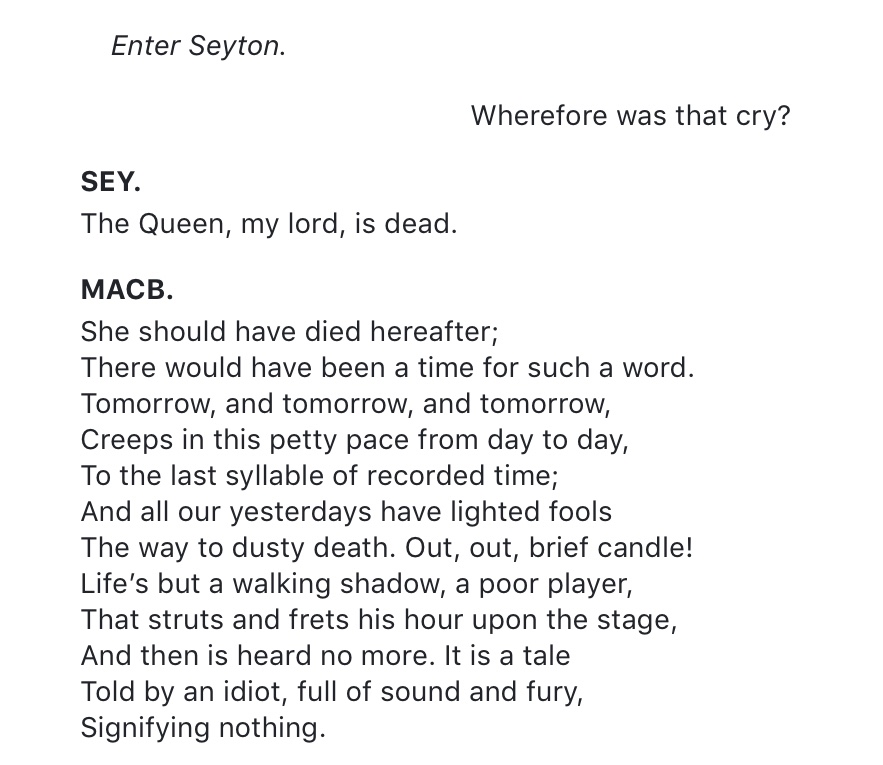
This short speech by Macbeth is his response to the news that Lady Macbeth is dead. It is not as emotional as Macduff’s response to the death of his wife and children, but instead is quite poignant and philosophical. A soliloquy might have been more expansive on his thoughts and feelings.
It is a reflection on the brevity and meaninglessness of life. Every day we live is someone else’s last, and our stories are full of noise and bother, but ultimately pointless.
Perhaps he anticipated her death, given her descent into guilty madness. His observation that “She should have died hereafter; There would have been time for such a word” suggests that he thought he had bigger problems at that point, and he simply didn’t have time to grieve properly. Implying that her timing was inconvenient is the kind of self-interest that those who love to hate Macbeth might find satisfying.
Either way, Macbeth’s musings on the futility of life contrast profoundly with his belief in his own invincibility and his headstrong determination to fight to keep the kingdom he usurped by killing Duncan and blaming it on his bodyguards.
It just goes to show that you can not encapsulate a character in one quotation or by examining one event. Shakespeare’s leading characters are complex, conflicted individuals designed to provoke thought and conscience. Macbeth is no exception.
While Shakespeare isn’t renowned for writing horror, he certainly understood the power of a macabre scene and the dramatic impact of horror when portraying just how evil a character could be. He created a number of beautifully creepy and macabre scenes that hold definite appeal for horror fans, and which make great reading for October and Halloween.
The Problem of Female Agency in Shakespeare’s ‘The Taming of the Shrew’ #women #Shakespeare #ShakespeareSunday
The horror of Act 5, Scene 1 of Macbeth is subtle, but very real. While there is no real blood on the stage, there is definitely blood on Lady Macbeth’s hands.
After belittling Macbeth more than once for being haunted by visions and ghosts, the same thing happens to Lady Macbeth – or Lady Macdeath, as I like to call her. She is spared such public humiliation, though – her suffering is is revealed in the privacy of her own rooms, witnessed only by her servant and a doctor. This enables the audience to witness the intensely personal and intimate nature of the psychological horror experienced by Lady Macbeth.
In the chaos of her behaviour, the audience sees the extent of Lady Macbeth’s mental torment: she is plagued by guilt and losing her grip on reality. She walks and talks in her sleep, carrying a candle because she cannot bear to be in darkness, and speaking of fragments of bloody images and events. She repeatedly acts as though she is washing her hands, sometimes for fifteen minutes, yet she can never seem to get them clean. She keeps on finding blood on her hands: “Yet here’s a spot.”
Despair and frustration underscore pronouncements such as “Out, damned spot! Out, I say!” and “What! will these hands ne’er be clean?
In her mind, she can still clearly smell and see the blood on her own hands after the murder of Duncan, observing “Here’s the smell of the blood still: all the perfumes of Arabia will not sweeten this little hand. Oh! oh! oh!”.
The doctor and gentlewoman who look on within the scene are disturbed by what they see before them, positioning the audience to share in their disquiet. Her macabre imagery and references to blood and ghosts cause the doctor to conclude that “Unnatural deeds Do breed unnatural troubles; infected minds To their deaf pillows will discharge their secrets; More needs she the divine than the physician.”
The doctor speaks what the audience already knows: it is Lady Macbeth’s conscience rather than her hands that cannot be cleansed. When he instructs the gentlewoman to watch her carefully and remove anything that she might use to harm herself, he is alluding to things that Shakespeare’s generally superstitious audiences would have interpreted as horrific in itself – spiritual torment as a result of one’s own sins, and the thought of committing suicide in such a state, were appalling and dreadful to those who had been taught of the eternal damnation of one who took their own life or died otherwise completely unreconciled with God. The good folk of early modern England feared many things, but burial in unconsecrated ground and spending eternity in hell were right at the top of most people’s list of things they wanted to avoid. Had it been otherwise, the early modern church would have been far less powerful and prominent in the lives of the English people.
Throughout this scene, the power of a guilty conscience over one’s psyche is vividly expressed using the depiction and the imagery of horror.
Shakespeare also uses the Macbeths’ experiences as a distinct reminder of the fact that regicide is never a good idea because the consequences are enormous for the nation as a whole, but it also has significant and permanent spiritual consequences for the perpetrators. Given the number of plots against James I, a Scottish king long before he became an English one, this was a politically expedient message for Shakespeare to deliver to his audiences while at the same time telling a deliciously dark and macabre story.
The Problem of Female Agency in Shakespeare’s ‘The Taming of the Shrew’ #women #Shakespeare #ShakespeareSunday
Macbeth is a play that has always fascinated people, engaging their superstitions as well as their imaginations. For this reason, its often called The Scottish Play by actors and theatre folk, as it’s believed to be unlucky to say ‘Macbeth’ in a theatre.
It’s a cracker of a story. The supernatural ‘weird sisters’ tell Macbeth he’s going to be Thane of Cawdor, and then tell him he is going to be king. In response, Macbeth does everything in his power to make it happen, only to be haunted by his victims and unable to actually enjoy his success when it does. You really do have to wonder how it would have all worked out if he’d responded with, “That’s nice!” and let things happen as they would.
Of course, you can’t just blame it all on Macbeth. His wife – whom I like to call Lady Macdeath – plays a significant part in engineering him onto the throne, mostly by bullying him into doing things he doesn’t really want to do.
The play has some fabulous macabre moments— the witches are spooky, their prophecies are uncanny, and you can bet your last dollar you don’t want to eat what they’re cooking in that cauldron. Even better is the part where Banquo’s ghost shows up for dinner shaking his “gory locks”: that is my favourite scene in the whole play.
Laced with suspense, intrigue, and dramatic irony, ‘Macbeth’ keeps the audience hooked to the very end, even though we all know by now how it’s going to work out. There’s more magic than just “Double, double, toil and trouble / Fire burn and cauldron bubble” in this play.
Strangely enough, reading the text has brought me some odd comfort this weekend as I contemplate the fate of people who manipulate, lie and use others for their own nefarious purposes. I have taken dark satisfaction in seeing those who chose to do evil get what they deserved in the end. It may not be gracious, but it is quite therapeutic to think that maybe the Fates really do have things under control. Sometimes you need to take your catharsis wherever you can get it.
That, of course, is the genius of all Shakespeare’s plays. He deals in the emotions we all understand – ambition, greed, love, anger, jealousy, pride, and the experience of being at the receiving end of the bad behaviour of others. The language may have changed slightly, but human nature certainly has not.
Shakespeare doesn’t have to work hard to make the audience dislike Macbeth and his cold-hearted shrew of a wife: we get it. We have all seen people succeed by means of deceiving and manipulating others, or by stabbing someone else in the back, and we don’t like them, either.



 Shakespeare Nerd