“Thou art too malapert…”

Peacock malapert know-it-all overconfident showy
Image from PublicDomainPictures on Pixabay

Malapert refers to a person who acts like they know everything and is confident that they are always right.ย 

While there are a number of characters in Shakespeare’s works whom we might consider to be malapert, Shakespeare uses the word only three times in his plays.

In Henry 6, Queen Margaret and her son, the young Lancaster Prince Edward, engage in a contest of insults with their captors: Clarence and Gloucester. As sons of Richard, Duke of York these two are the Lancastrian King Henry’s enemies, as the two houses are rivals for the English throne. Clarence calls the young prince malapert, highlighting his youthful confidence by calling him an โ€œuntutorโ€™d ladโ€. 

Almost as proof of Clarenceโ€™s assessment, the prince responds by insulting them again. Despite the clevernesand bravery of his words, this proved to be a bad move, as โ€œperjurโ€™d Georgeโ€ and โ€œmisshapen Dickโ€ respond by stabbing him to death. End of argument. 

In Richard III, the same Queen Margaret tells the Marquess of Dorset that he is malapert and warns him that his newly found nobility wonโ€™t protect him from being destroyed by the Yorks, particularly Richard (Gloucester) whom  she describes as a โ€œbottled spiderโ€ and a โ€œpoisonous bunch-backโ€™d toad”. Richard turns the insult back on Margaret, and Dorset promptly turns it right back on him. 

In the comedy Twelfth Night, Sir Toby Belch and Sebastian are engaged in an argument when Sir Toby insists that he โ€œmust have an ounce or two of this malapert bloodโ€ from his rival. 

Malapert
#words #Shakespeare #ShakespeareSunday

Book Review: The RSC Shakespeare – The Complete Works

The Complete Works, produced by the Royal Shakespeare Company and edited by Jonathan Bale and Eric Rasmussen, is a brilliant book. 

Having read and enjoyed several of the RSC texts of individual plays,

As always with RSC editions of individual plays, the notes provided are excellent. Each play has a thoughtful introduction that explores key ideas and themes, as well as providing insights for dramaturgy, performance and production.

The printing is clear, and of a good size โ€”  not so small that it is almost impossible to read, as with many collected works editions โ€”  and the paper quality is beautiful.

In addition to the texts, there are pages of annotated photographs and illustrations to give added context and to highlight RSC performances of the plays.

Physically, it is quite a big book, so it is  most comfortably used on a desk or table. The paperback is lighter in weight, but I am a little disappointed that I did not buy the hard cover edition, as that would make it more durable.  

Even so, Iโ€™m delighted with this volume and have found it very useful thus far.  Should I find that my paperback does not stand the test of time and regular use, I will definitely invest in a hard cover copy, as this is a book I will want to read and make use of for many years to come.

Desdemonaโ€™s Lament

Photo by Kaboompics .com on Pexels.com

Often when I see a willow tree, I think of the  desperately sad song sung by Ophelia as she prepares for bed in Act 4, scene 3 of โ€˜Othelloโ€™.

โ€˜Willowโ€™ is a folk song that tells of lost love and resulting tragedy, although Ophelia doesnโ€™t quite get that far in the song before she stops to talk with her maid, Emilia. The song was not written by Shakespeare, and it seems to have been widely enough known for the audience to have understood the gravity and foreboding of it being sung by Ophelia. 

Shakespeare did, however, make one significant change. The original song was about a man dying as the result of the cruelty of a woman, but when Ophelia sings it, the song is about a woman suffering at the hands of the man she loves. 

The poignancy of the song is heightened by Opheliaโ€™s revelation to Emilia that her motherโ€™s maid, from whom she learned the song, died tragically while singing it. 


The song takes another tragic twist when Emilia herself sings the song as she, too, dies from injuries inflicted by her own husband. 

Shakespeare uses this song to evoke pathos,  tragedy and foreboding in abundance. 

It seems to me that he willow tree, graceful and mournful at the same time, is a most fitting image for achieving that effect.


Desdemonaโ€™s Lament.
#Shakespeare #Othello #willow #tragedy #ShakesepeareNerd #blogpost

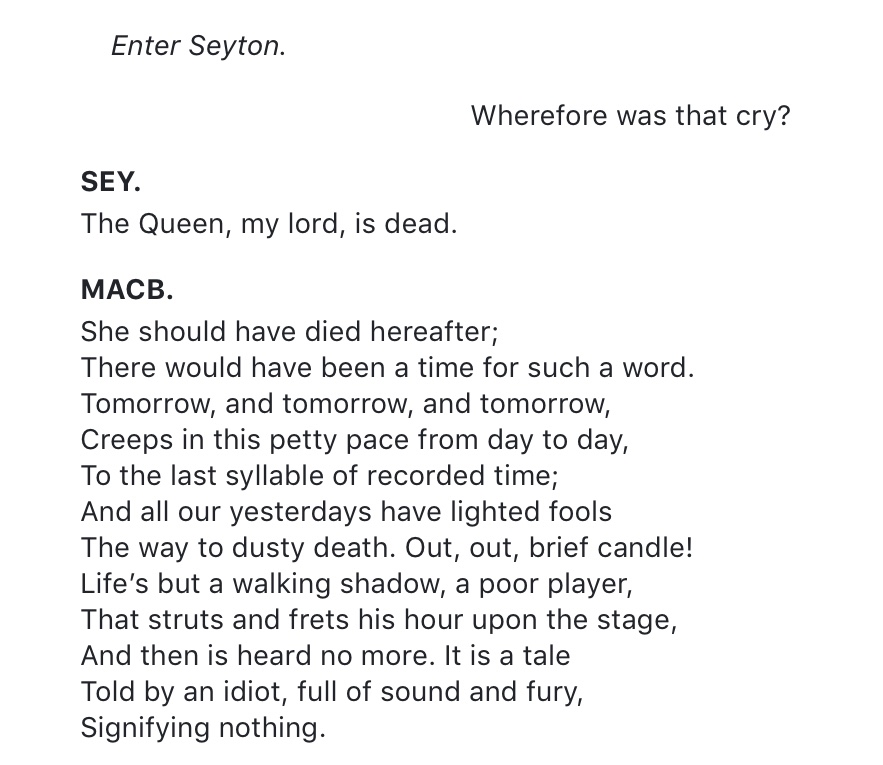
Lifeโ€™s But A Walking Shadow

Macbeth, V.v

This short speech by Macbeth is his response to the news that Lady Macbeth is dead. It is not as emotional as Macduffโ€™s response to the death of his wife and children, but instead is quite poignant and philosophical. A soliloquy might have been more expansive on his thoughts and feelings.

It is a reflection on the brevity and meaninglessness of life. Every day we live is someone elseโ€™s last, and our stories are full of noise and bother, but ultimately pointless. 

Perhaps he anticipated her death, given her descent into guilty madness. His observation that โ€œShe should have died hereafter; There would have been time for such a wordโ€ suggests that he thought he had bigger problems at that point, and he simply didnโ€™t have time to grieve properly. Implying that her timing was inconvenient is the kind of self-interest that those who love to hate Macbeth might find satisfying. 

Either way, Macbethโ€™s musings on the futility of life contrast profoundly with his belief in his own invincibility and his headstrong determination to fight to keep the kingdom he usurped by killing Duncan and blaming it on his bodyguards. 

It just goes to show that you can not encapsulate a character in one quotation or by examining one event. Shakespeareโ€™s leading characters are complex, conflicted individuals designed to provoke thought and conscience. Macbeth is no exception. 

21st Century Ways to Entertain Yourself in the Shakes-sphere

Contrary to what some people might think, enjoying Shakespeare isnโ€™t all about seeing performances of plays, being academic, and knowinf your โ€œtheesโ€ from your โ€œthousโ€.

These apps for smart phone or tablet will appeal to devoted Bardophiles looking for new ways to enjoy Shakespeare, but also to students looking for ways to enrich and extend their knowledge of Shakespeareโ€™s works.

There are loads of Shakespeare-related apps out there, but of all the ones Iโ€™ve tried, these three are the ones I have kept and continue to use.

Emoji Shakespeare has a variety of passages from well-known plays in which one is required to โ€˜fill in the blanksโ€™ with emojis. Itโ€™s a great way to pass a bit of spare time, and definitely more interesting than endless reiterations of Candy Crush.

ShakesQuiz is a multiple choice quiz game that covers the plays, poetry, life and times of Shakespeare. Each quiz is ten questions long. Hints can be purchased if one is unwilling to achieve less than perfect scores. I prefer to think of it as something to improve on next time!

The Shakespeare Pro app offers a digital collection of Shakespeareโ€™s works, analysis, quotes, and the facility to make and save notes. The search function is comprehensive and customisable, enabling a specific search within a particular work or across the entire canon.


If you have an app you enjoy, please leave your recommendation in a comment.

Knowing Your Literary Devices.

Knowing the literary devices used by Shakespeare and how they work helps those who read or study his works understand the ways in which he has shaped and crafted meaning in the lines delivered by his characters and in his poetry. It also helps readers to recognise the difference between literal and figurative language, and therefore to interpret more correctly the message of particular lines and scenes, and of texts as a whole. 

Of course, there are the standard ones that everyone should learn in school: simile, metaphor, alliteration, repetition hyperbole.  In senior high, that should extend to more sophisticated devices specific to the text being studied. My senior English class is studying โ€˜RichardIIIโ€™, so they are learning about stichomythia, anaphora and antithesis among others. Irony and dramatic irony are also heavy hitters in this play, so while they are by no means new concepts to the students, we are discussing them in detail. 

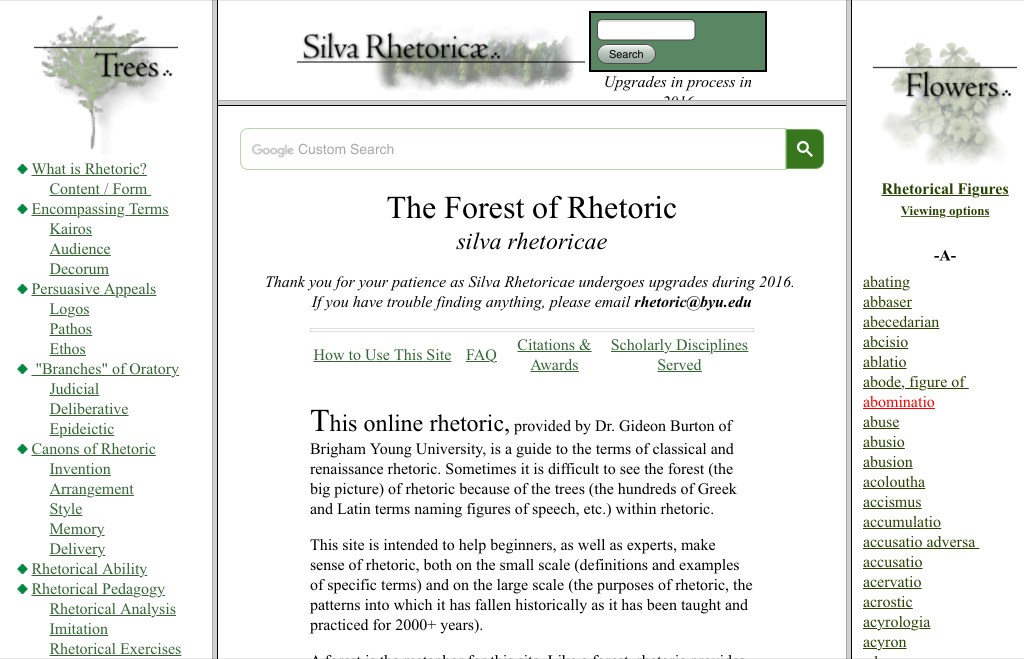
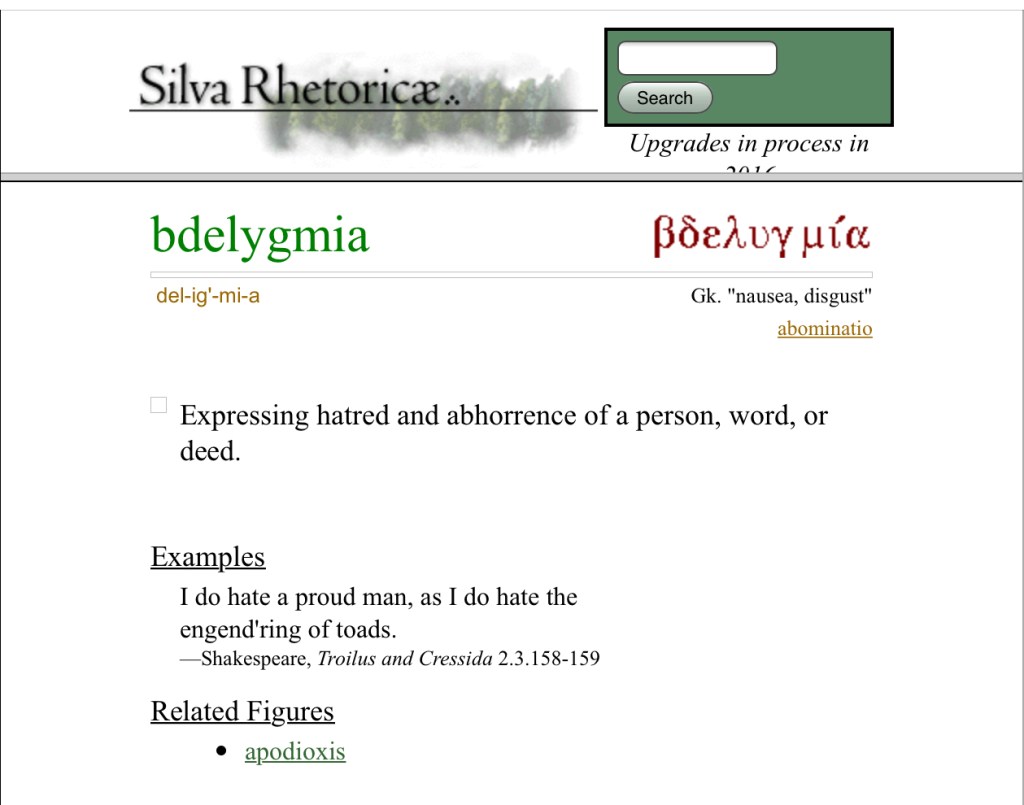
An excellent online resource for the definition and demonstration of rhetorical devices used by Shakespeare and many other dramatists, orators and writers is Silva Rhetoricรฆ.

The site is knowledgeable and fairly thorough, although some terms relating to Shakespeareโ€™s plays are not included. The names of rhetorical devices are listed alphabetically, and the definitions are written in plain English with examples and alternative terms provided. There is also a handy pronunciation guide, which is really helpful when it comes to terms like โ€˜bdelygmiaโ€™ and โ€˜symploceโ€™.ย 

While I do not expect my students to use the same degree of metalanguage that university students might use, there is definitely credit in nailing the key terms and using them to write about a text with greater eloquence and sophistication. 

Horror In Shakespeare: The Haunting of Richard III

While Shakespeare isnโ€™t renowned for writing horror, he certainly understood the power of a macabre scene and the dramatic impact of horror when portraying just how evil a character could be.ย 
He created a number of beautifully creepy and macabre scenes that hold definite appeal for horror fans, and which make great reading for October and Halloween.ย 

Of all the scenes written by Shakespeare, this is the most Halloween-worthy. What is more appropriate for All Hallowโ€™s Eve than a haunting, right?

Shakespeareโ€™s โ€˜Richard IIIโ€™ portrays Richard as an evil, conniving, murderous villain who plots and murders his way onto the throne of England. His deeds are ruthless and his victims are many.

In Act 5, Scene 3, the ghosts of all of Richardโ€™s victims haunt him in his tent the night before the battle. Each of them bids him to โ€œdespair and dieโ€, which becomes a powerful refrain that haunts him as he sleeps. This kind of regular repetition of a phrase is called epimone (uh-pim-o-nee): it compounds and gives power to an idea by dwelling on it.

 Each of the ghosts also visits Richardโ€™s opponent, Richmond, as he sleeps, bidding him to live, conquer and flourish. It is significant that their words to him are not so distinctly and deliberately repeated and echoed as they are to Richard. They are content to give him their various blessings, while they are intent on cursing Richard in no uncertain terms. 

This is a beautifully crafted and deliciously vindictive sequence of indictment and cursing, in which the eloquence of the language only adds to the darkness of the scene. 

The haunting definitely disturbs Richard, who responds to his troubled dreams with a soliloquy that uses strong imagery of guilt and judgement, and of fear and cowardice, revealing the disquiet of his conscience and his mind. He, too, uses the words โ€œdespairโ€ and โ€œdieโ€ immediately before referencing the visitation of the ghosts, showing that even though he thought it was a dream, they have had a profound effect on his spirit. 

The Problem of Female Agency in Shakespeare’s ‘The Taming of the Shrew’
#women #Shakespeare #ShakespeareSunday

You can read the whole scene, or the entire play, here