Often when I see a willow tree, I think of the desperately sad song sung by Ophelia as she prepares for bed in Act 4, scene 3 of ‘Othello’.
‘Willow’ is a folk song that tells of lost love and resulting tragedy, although Ophelia doesn’t quite get that far in the song before she stops to talk with her maid, Emilia. The song was not written by Shakespeare, and it seems to have been widely enough known for the audience to have understood the gravity and foreboding of it being sung by Ophelia.
Shakespeare did, however, make one significant change. The original song was about a man dying as the result of the cruelty of a woman, but when Ophelia sings it, the song is about a woman suffering at the hands of the man she loves.
The poignancy of the song is heightened by Ophelia’s revelation to Emilia that her mother’s maid, from whom she learned the song, died tragically while singing it.
The song takes another tragic twist when Emilia herself sings the song as she, too, dies from injuries inflicted by her own husband.
Shakespeare uses this song to evoke pathos, tragedy and foreboding in abundance.
It seems to me that he willow tree, graceful and mournful at the same time, is a most fitting image for achieving that effect.
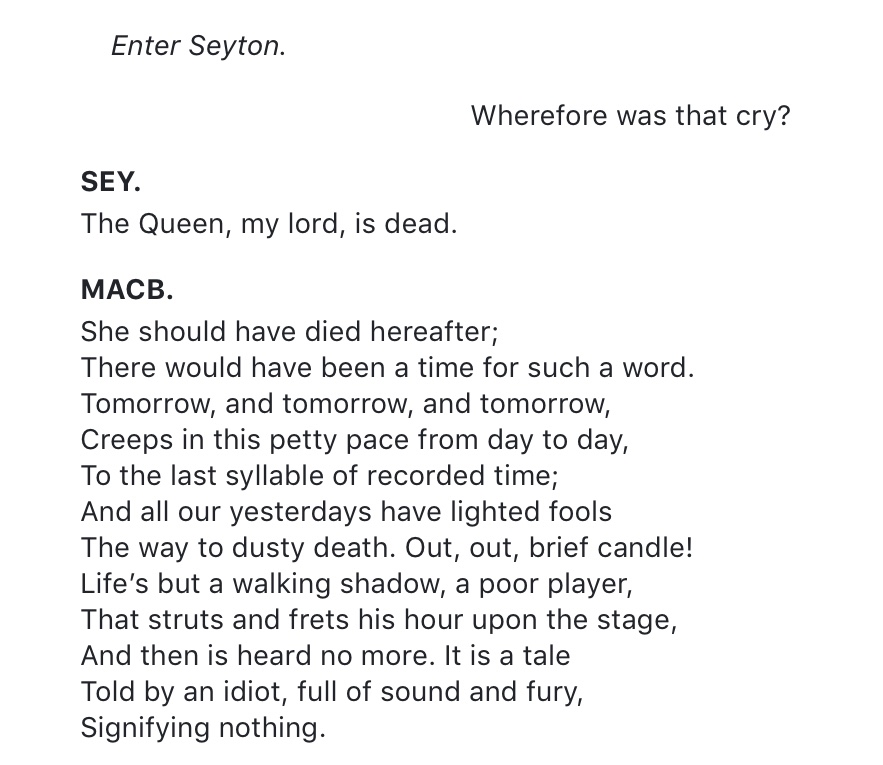
This short speech by Macbeth is his response to the news that Lady Macbeth is dead. It is not as emotional as Macduff’s response to the death of his wife and children, but instead is quite poignant and philosophical. A soliloquy might have been more expansive on his thoughts and feelings.
It is a reflection on the brevity and meaninglessness of life. Every day we live is someone else’s last, and our stories are full of noise and bother, but ultimately pointless.
Perhaps he anticipated her death, given her descent into guilty madness. His observation that “She should have died hereafter; There would have been time for such a word” suggests that he thought he had bigger problems at that point, and he simply didn’t have time to grieve properly. Implying that her timing was inconvenient is the kind of self-interest that those who love to hate Macbeth might find satisfying.
Either way, Macbeth’s musings on the futility of life contrast profoundly with his belief in his own invincibility and his headstrong determination to fight to keep the kingdom he usurped by killing Duncan and blaming it on his bodyguards.
It just goes to show that you can not encapsulate a character in one quotation or by examining one event. Shakespeare’s leading characters are complex, conflicted individuals designed to provoke thought and conscience. Macbeth is no exception.
Contrary to what some people might think, enjoying Shakespeare isn’t all about seeing performances of plays, being academic, and knowinf your “thees” from your “thous”.
These apps for smart phone or tablet will appeal to devoted Bardophiles looking for new ways to enjoy Shakespeare, but also to students looking for ways to enrich and extend their knowledge of Shakespeare’s works.
There are loads of Shakespeare-related apps out there, but of all the ones I’ve tried, these three are the ones I have kept and continue to use.
Emoji Shakespeare has a variety of passages from well-known plays in which one is required to ‘fill in the blanks’ with emojis. It’s a great way to pass a bit of spare time, and definitely more interesting than endless reiterations of Candy Crush.
ShakesQuiz is a multiple choice quiz game that covers the plays, poetry, life and times of Shakespeare. Each quiz is ten questions long. Hints can be purchased if one is unwilling to achieve less than perfect scores. I prefer to think of it as something to improve on next time!
The Shakespeare Pro app offers a digital collection of Shakespeare’s works, analysis, quotes, and the facility to make and save notes. The search function is comprehensive and customisable, enabling a specific search within a particular work or across the entire canon.
If you have an app you enjoy, please leave your recommendation in a comment.
Knowing the literary devices used by Shakespeare and how they work helps those who read or study his works understand the ways in which he has shaped and crafted meaning in the lines delivered by his characters and in his poetry. It also helps readers to recognise the difference between literal and figurative language, and therefore to interpret more correctly the message of particular lines and scenes, and of texts as a whole.
Of course, there are the standard ones that everyone should learn in school: simile, metaphor, alliteration, repetition hyperbole. In senior high, that should extend to more sophisticated devices specific to the text being studied. My senior English class is studying ‘RichardIII’, so they are learning about stichomythia, anaphora and antithesis among others. Irony and dramatic irony are also heavy hitters in this play, so while they are by no means new concepts to the students, we are discussing them in detail.
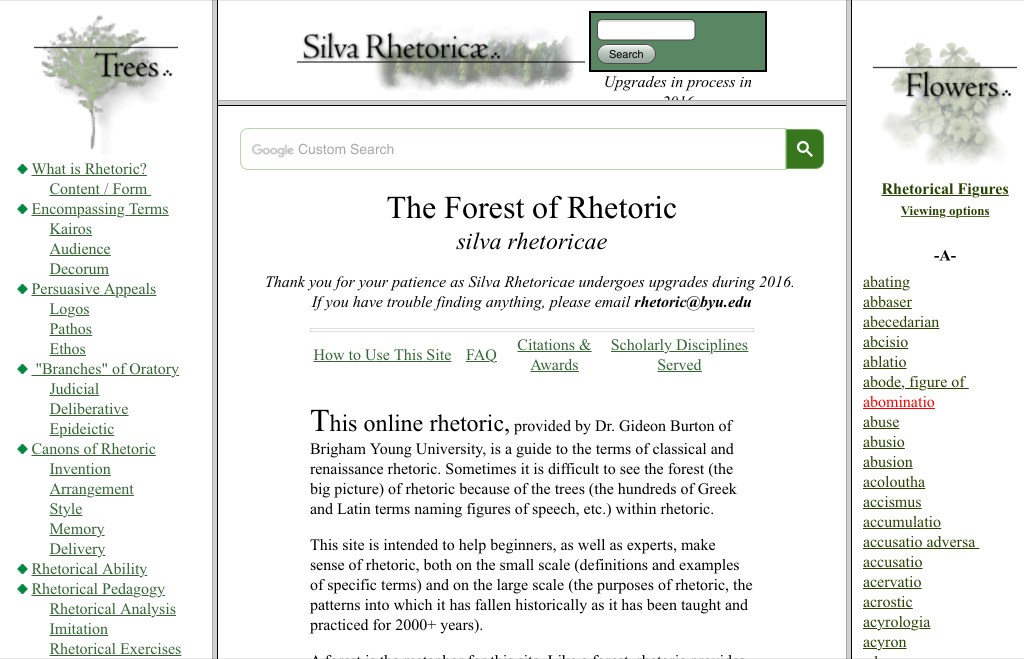
An excellent online resource for the definition and demonstration of rhetorical devices used by Shakespeare and many other dramatists, orators and writers is Silva Rhetoricæ.
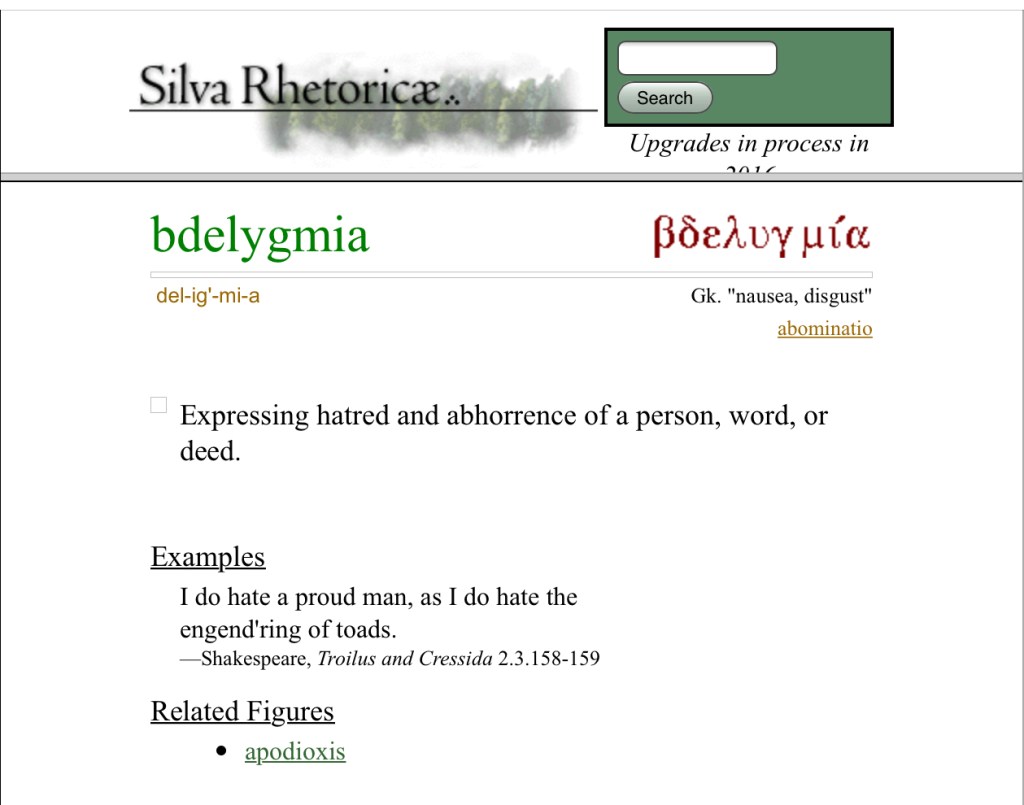
The site is knowledgeable and fairly thorough, although some terms relating to Shakespeare’s plays are not included. The names of rhetorical devices are listed alphabetically, and the definitions are written in plain English with examples and alternative terms provided. There is also a handy pronunciation guide, which is really helpful when it comes to terms like ‘bdelygmia’ and ‘symploce’.
While I do not expect my students to use the same degree of metalanguage that university students might use, there is definitely credit in nailing the key terms and using them to write about a text with greater eloquence and sophistication.
Following yesterday’s post about the early years of Shakespeare, I’m pleased to share with you Mumble Theatre’s second part of their article on the young Shakespeare.
While Shakespeare isn’t renowned for writing horror, he certainly understood the power of a macabre scene and the dramatic impact of horror when portraying just how evil a character could be. He created a number of beautifully creepy and macabre scenes that hold definite appeal for horror fans, and which make great reading for October and Halloween.
Of all the scenes written by Shakespeare, this is the most Halloween-worthy. What is more appropriate for All Hallow’s Eve than a haunting, right?
Shakespeare’s ‘Richard III’ portrays Richard as an evil, conniving, murderous villain who plots and murders his way onto the throne of England. His deeds are ruthless and his victims are many.
In Act 5, Scene 3, the ghosts of all of Richard’s victims haunt him in his tent the night before the battle. Each of them bids him to “despair and die”, which becomes a powerful refrain that haunts him as he sleeps. This kind of regular repetition of a phrase is called epimone (uh-pim-o-nee): it compounds and gives power to an idea by dwelling on it.
Each of the ghosts also visits Richard’s opponent, Richmond, as he sleeps, bidding him to live, conquer and flourish. It is significant that their words to him are not so distinctly and deliberately repeated and echoed as they are to Richard. They are content to give him their various blessings, while they are intent on cursing Richard in no uncertain terms.
This is a beautifully crafted and deliciously vindictive sequence of indictment and cursing, in which the eloquence of the language only adds to the darkness of the scene.
The haunting definitely disturbs Richard, who responds to his troubled dreams with a soliloquy that uses strong imagery of guilt and judgement, and of fear and cowardice, revealing the disquiet of his conscience and his mind. He, too, uses the words “despair” and “die” immediately before referencing the visitation of the ghosts, showing that even though he thought it was a dream, they have had a profound effect on his spirit.
The Problem of Female Agency in Shakespeare’s ‘The Taming of the Shrew’ #women #Shakespeare #ShakespeareSunday
While Shakespeare isn’t renowned for writing horror, he certainly understood the power of a macabre scene and the dramatic impact of horror when portraying just how evil a character could be. He created a number of beautifully creepy and macabre scenes that hold definite appeal for horror fans, and which make great reading for October and Halloween.
The Problem of Female Agency in Shakespeare’s ‘The Taming of the Shrew’ #women #Shakespeare #ShakespeareSunday
The horror of Act 5, Scene 1 of Macbeth is subtle, but very real. While there is no real blood on the stage, there is definitely blood on Lady Macbeth’s hands.
After belittling Macbeth more than once for being haunted by visions and ghosts, the same thing happens to Lady Macbeth – or Lady Macdeath, as I like to call her. She is spared such public humiliation, though – her suffering is is revealed in the privacy of her own rooms, witnessed only by her servant and a doctor. This enables the audience to witness the intensely personal and intimate nature of the psychological horror experienced by Lady Macbeth.
In the chaos of her behaviour, the audience sees the extent of Lady Macbeth’s mental torment: she is plagued by guilt and losing her grip on reality. She walks and talks in her sleep, carrying a candle because she cannot bear to be in darkness, and speaking of fragments of bloody images and events. She repeatedly acts as though she is washing her hands, sometimes for fifteen minutes, yet she can never seem to get them clean. She keeps on finding blood on her hands: “Yet here’s a spot.”
Despair and frustration underscore pronouncements such as “Out, damned spot! Out, I say!” and “What! will these hands ne’er be clean?
In her mind, she can still clearly smell and see the blood on her own hands after the murder of Duncan, observing “Here’s the smell of the blood still: all the perfumes of Arabia will not sweeten this little hand. Oh! oh! oh!”.
The doctor and gentlewoman who look on within the scene are disturbed by what they see before them, positioning the audience to share in their disquiet. Her macabre imagery and references to blood and ghosts cause the doctor to conclude that “Unnatural deeds Do breed unnatural troubles; infected minds To their deaf pillows will discharge their secrets; More needs she the divine than the physician.”
The doctor speaks what the audience already knows: it is Lady Macbeth’s conscience rather than her hands that cannot be cleansed. When he instructs the gentlewoman to watch her carefully and remove anything that she might use to harm herself, he is alluding to things that Shakespeare’s generally superstitious audiences would have interpreted as horrific in itself – spiritual torment as a result of one’s own sins, and the thought of committing suicide in such a state, were appalling and dreadful to those who had been taught of the eternal damnation of one who took their own life or died otherwise completely unreconciled with God. The good folk of early modern England feared many things, but burial in unconsecrated ground and spending eternity in hell were right at the top of most people’s list of things they wanted to avoid. Had it been otherwise, the early modern church would have been far less powerful and prominent in the lives of the English people.
Throughout this scene, the power of a guilty conscience over one’s psyche is vividly expressed using the depiction and the imagery of horror.
Shakespeare also uses the Macbeths’ experiences as a distinct reminder of the fact that regicide is never a good idea because the consequences are enormous for the nation as a whole, but it also has significant and permanent spiritual consequences for the perpetrators. Given the number of plots against James I, a Scottish king long before he became an English one, this was a politically expedient message for Shakespeare to deliver to his audiences while at the same time telling a deliciously dark and macabre story.
The Problem of Female Agency in Shakespeare’s ‘The Taming of the Shrew’ #women #Shakespeare #ShakespeareSunday
While Shakespeare isn’t renowned for writing horror, he certainly understood the power of a macabre scene and the dramatic impact of horror when portraying just how evil a character could be. He created a number of beautifully creepy and macabre scenes that hold definite appeal for horror fans, and which make great reading for October and Halloween.
‘Hamlet’ opens with a spooky, although not macabre, scene. This scene is all about those common elements that make horror work: creepy chills, fear and dread.
It’s the dead of night and the guards at Elsinore Castle are going about their regular duties, except that they seem nervous: Bernardo opens with the line “Who’s there?” and Marcellus leads their conversation leads with, “What, has this thing appeared again tonight?”
They are discussing the apparition that has appeared to them on the two previous nights. As they talk, the ghost appears again. It doesn’t speak to them, it doesn’t harm them… but it definitely scares them.
As they discuss the ghost and hypothesise as to whether or not it’s a bad omen, it returns, spreads its arms wide, and then disappears when a rooster crows.
Afterwards, Horatio tells Hamlet about seeing the ghost, and gives more detail of how frightened they were.
Like them, Hamlet thinks the appearance of the ghost is a sign that all is not right. His response is to keep watch with them that night, and when the ghost appears, he addresses it as his father’s ghost and entreats it to tell him what he needs to do.
Still fearful, Marcellus and Horatio tell Hamlet not to go with the ghost. He does, of course. How else would he find out what it wants to say to him?
It’s fair to say that Hamlet is more appalled by what the ghost of his father tells him than he is by seeing the ghost in the first place. The ghost says he was murdered by Claudius and urges Hamlet to take revenge, which is what drives the action of the remainder of the play.
The Problem of Female Agency in Shakespeare’s ‘The Taming of the Shrew’ #women #Shakespeare #ShakespeareSunday
This might not seem terrifying to audiences in the 21st century, but Shakespeare’s audiences were far more superstitious than we are, and they understood the significance of ghosts and omens. Just as the soldiers in the play “tremble and look pale”, most of the people in the early modern audience would likewise have taken that apparition very seriously.
This is delicious creepy horror that foreshadowed the Gothic style made popular by authors such as Walpole, Shelley, Stoker, Lovecraft, and even Charles Dickens, among others.






 Shakespeare Nerd